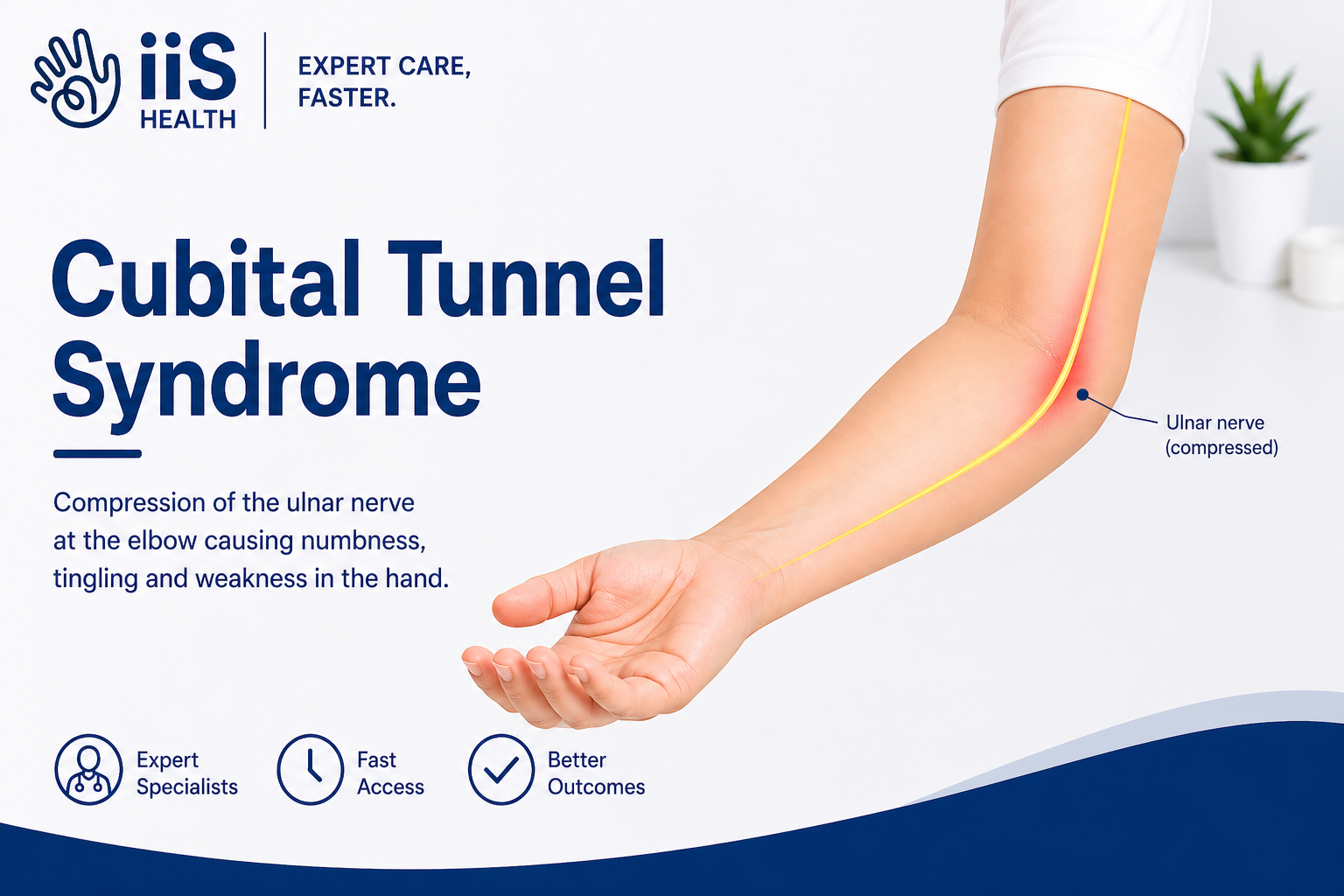
Cubital tunnel syndrome is a condition caused by increased pressure on the ulnar nerve as it passes through the cubital tunnel at the elbow.
The ulnar nerve provides sensation to the little finger and part of the ring finger, as well as contributing to hand strength and coordination. It travels through a bony groove on the inner side of the elbow, commonly referred to as the “funny bone.”
When the nerve is compressed or irritated in this area, it can lead to sensory changes and, in more advanced cases, weakness in the hand.
There are a number of causes of cubital tunnel syndrome, although in many cases no single cause is identified.
Anything that reduces the space available for the nerve within the cubital tunnel can lead to symptoms. This may include:
• Repeated or prolonged bending of the elbow
• Direct pressure on the inner aspect of the elbow
• Previous fractures or injury around the elbow
• Elbow arthritis
• Numbness and tingling in the little and ring fingers
• Symptoms that come and go, often worse when the elbow is bent
• Pain on the inner side of the elbow that may travel down the arm
• Weakness or clumsiness in the hand
• Difficulty with fine finger movements
Symptoms are often more noticeable at night or when the elbow is bent for prolonged periods, such as when sleeping or reading.
In more advanced cases, the small muscles of the hand may weaken or waste due to prolonged nerve compression.
Diagnosis is usually based on a detailed clinical history and examination.
Nerve conduction studies are typically required to confirm the diagnosis and assess the severity of nerve compression.
In some cases, imaging such as an X-ray may be needed to assess for underlying causes such as arthritis or previous injury around the elbow.
Treatment depends on the severity and duration of symptoms.
Non-surgical options may include:
• Avoiding prolonged elbow flexion
• Activity modification
• Splinting to keep the elbow in a more extended position
• Nerve gliding exercises
In many cases, particularly where symptoms are persistent or progressive, surgery may be required to prevent long-term nerve damage.
The most common surgical treatment involves releasing the structures overlying the ulnar nerve within the cubital tunnel to reduce pressure.
This is typically performed as a day-case procedure and can be done either under local anaesthetic or general anaesthetic.
In some cases, the nerve may be repositioned to the front of the elbow in a procedure known as an anterior transposition. This is usually reserved for more complex or recurrent cases, or where there is underlying joint deformity or damage.
The aim of surgery is to relieve pressure on the nerve and prevent further deterioration.
After surgery:
• A bulky dressing is applied for 48 hours
• This is replaced with a lighter dressing until around 10 days
• Stitches are usually dissolvable
Return to work:
• Sedentary roles: approximately 2 weeks
• Manual work: up to 6 weeks
Driving:
• Usually possible after 6–7 days
• May take up to 2 weeks for full comfort
Return to sport:
• Most activities: approximately 6 weeks
• High-demand sports: up to 3 months
As with any surgery, there are potential risks:
• Infection (around 1%), usually treated with antibiotics
• Swelling and stiffness, which may persist for several months
• Nerve irritation or injury (rare), potentially causing numbness
• Injury to the ulnar nerve (very rare), which may result in weakness or permanent numbness
Additional considerations:
• Recurrence is uncommon but possible
• Residual numbness may persist if symptoms were longstanding prior to surgery
• Recovery of sensation can take up to 18 months in some cases
• Complex Regional Pain Syndrome (CRPS), a rare complication causing prolonged pain, swelling and sensitivity
You should seek medical advice if:
• You experience persistent numbness or tingling in the little or ring fingers
• Symptoms worsen when bending the elbow
• You notice weakness or clumsiness in the hand
• Symptoms are progressing over time
Early treatment is important to prevent long-term nerve damage.




.png)