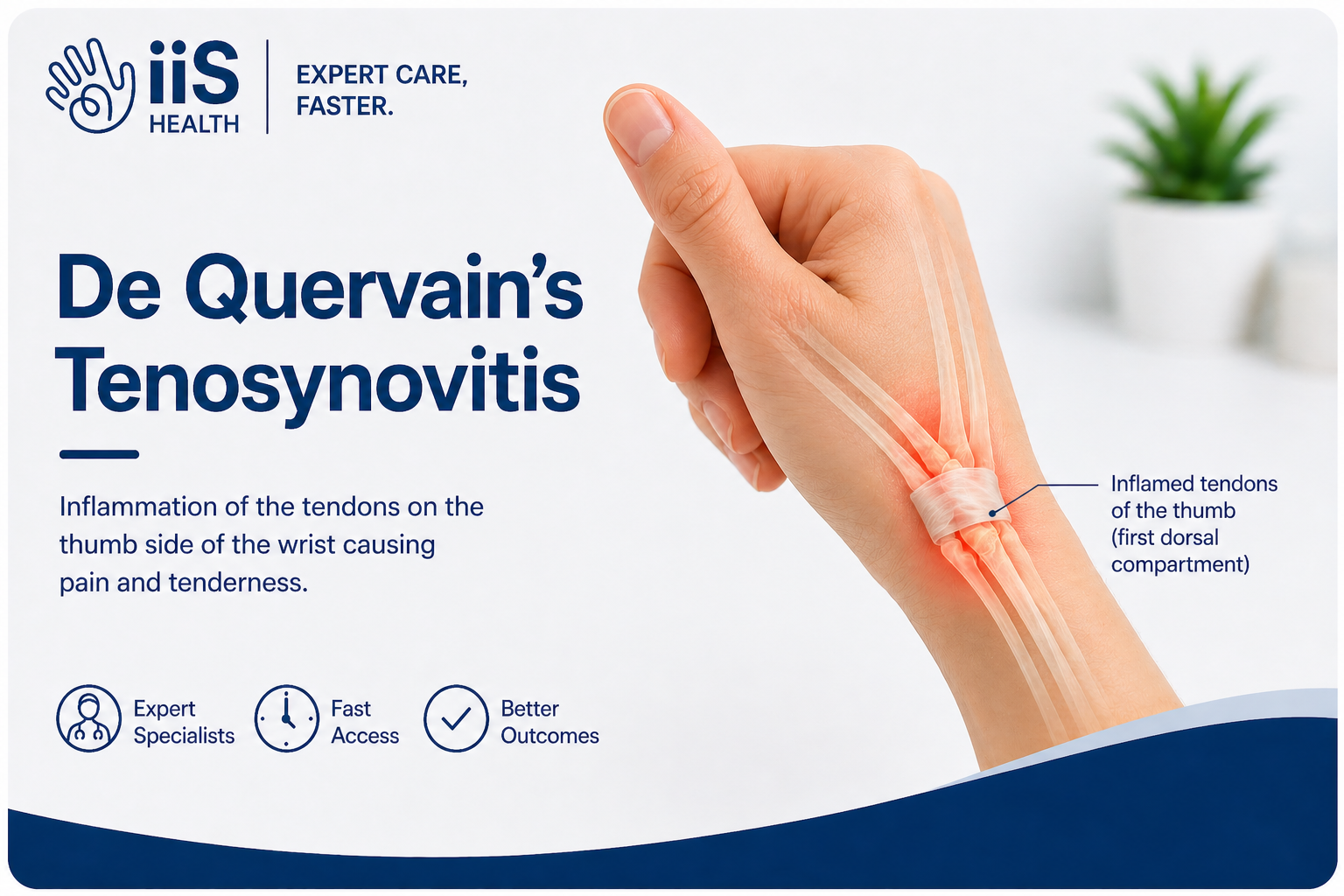
De Quervain’s tenosynovitis is a condition causing pain on the thumb side of the wrist due to irritation of the tendons that move the thumb away from the hand.
These tendons (Abductor Pollicis Longus and Extensor Pollicis Brevis) pass through a tight tunnel at the wrist beneath a ligament known as the extensor retinaculum. When the lining around these tendons becomes thickened, their movement is restricted, leading to pain and inflammation.
This can make simple activities involving the thumb uncomfortable and difficult.
The exact cause is not always clear, but the condition is commonly associated with:
• Repetitive gripping or lifting activities
• New mothers, due to repetitive lifting of a baby
• Occupations involving repeated hand and wrist movements
• Previous wrist injuries
• Inflammatory conditions such as rheumatoid arthritis
• Pain on the thumb side of the wrist
• Swelling and tenderness at the base of the thumb
• Pain that worsens with thumb or wrist movement
• Pain that may travel up the forearm
• Catching or grinding sensation with movement
Pain is typically aggravated by gripping, lifting, or twisting movements.
Diagnosis is usually made through a clinical history and examination.
An ultrasound scan may be used in some cases to assess the severity of the condition or when the diagnosis is uncertain.
Most patients improve with non-surgical treatment.
Non-operative management includes:
• Activity modification
• Splinting to rest the thumb and wrist
• Anti-inflammatory medication
• Hand therapy with exercises to improve tendon movement
Steroid injections can provide significant pain relief in up to 60% of patients.
Surgery is considered only when these measures fail to provide adequate relief.
Surgical treatment involves releasing the tight tunnel (extensor retinaculum) over the tendons to allow them to move freely.
This is performed as a day-case procedure, usually under local anaesthetic.
The aim is to reduce pressure on the tendons and relieve pain.
After surgery:
• A bulky dressing is applied for 48 hours
• This is replaced with a lighter dressing until around 10 days
• Stitches are usually dissolvable
Return to work:
• Sedentary roles: approximately 2 weeks
• Manual work: up to 6 weeks
Driving:
• Usually possible after 6–7 days
• May take up to 2 weeks for full comfort
Return to sport:
• Most activities: approximately 6 weeks
• High-demand sports: up to 3 months
As with any surgery, there are potential risks:
• Infection (around 1%), usually treated with antibiotics
• Swelling and stiffness, which may persist for several months
• Scar sensitivity
• Nerve irritation or injury (rare), particularly affecting nerves supplying the back of the thumb
Additional considerations:
• Recurrence is uncommon but possible
• Neuroma formation (rare), which may cause persistent pain
• Complex Regional Pain Syndrome (CRPS), a rare complication causing prolonged pain and sensitivity
You should seek medical advice if:
• You have persistent pain on the thumb side of the wrist
• Symptoms worsen with activity
• You experience difficulty with gripping or lifting
• Symptoms are not improving with rest
Early treatment can help prevent progression.




.png)