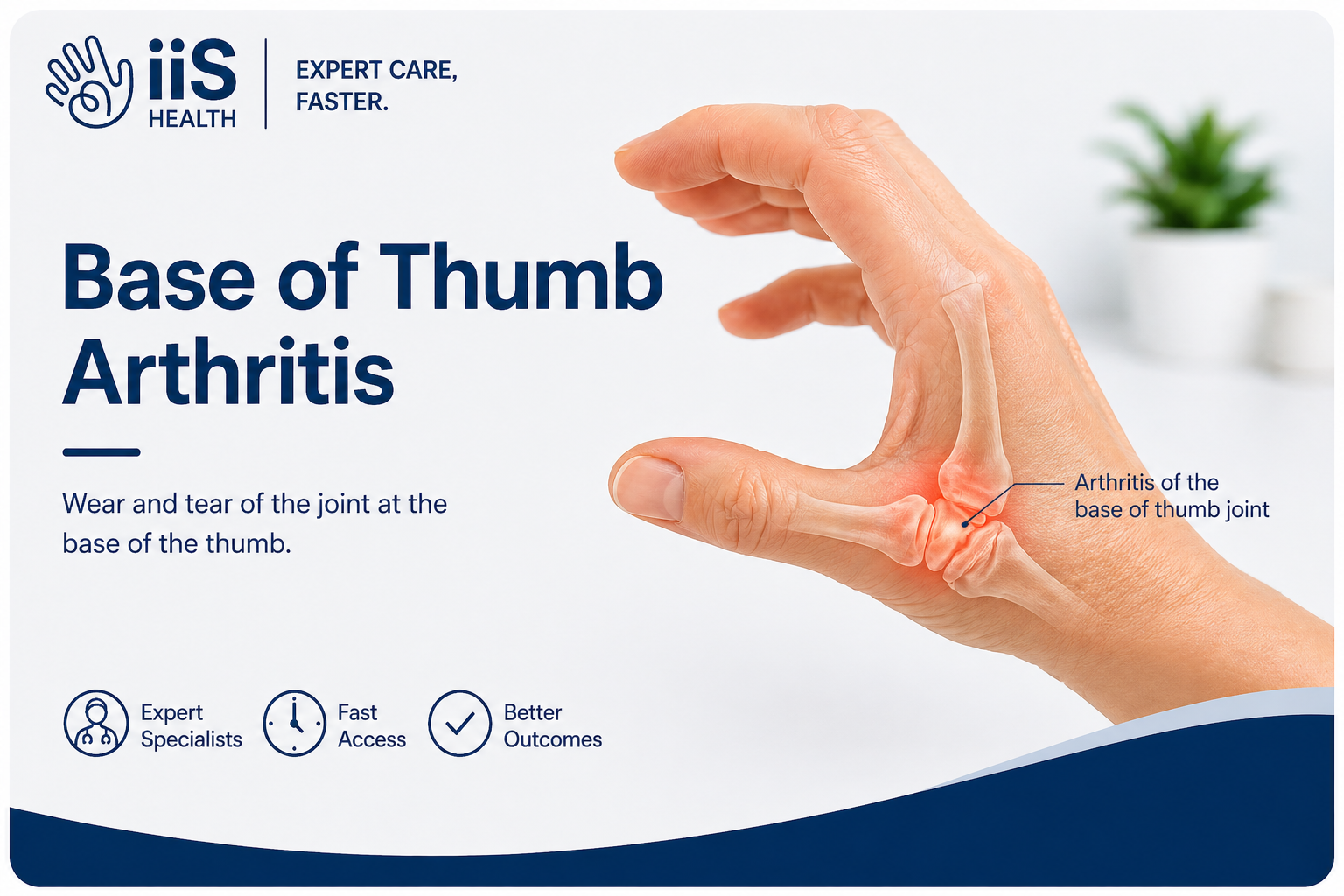
Base of thumb arthritis is a form of osteoarthritis affecting the joint between the base of the thumb metacarpal and the trapezium bone in the wrist.
This joint is highly mobile and subject to significant forces during everyday activities such as gripping and pinching. Over time, the cartilage within the joint wears down, leading to pain, stiffness, and reduced function.
This condition is very common, particularly in post-menopausal women. In men, it is more often associated with previous injury or fracture to the thumb.
The base of the thumb joint is one of the most heavily used joints in the body and is exposed to significant mechanical stress.
It is more common in:
• Patients over the age of 50
• Women, particularly after menopause
• Individuals with previous thumb injuries or fractures
Wear and tear over time leads to degeneration of the joint surfaces and development of osteoarthritis.
• Pain or burning sensation at the base of the thumb
• Stiffness, particularly in the morning
• Weakness when gripping or pinching
• Difficulty opening jars or turning keys
• Reduced range of motion
• Development of a bony lump at the base of the thumb
Pain is typically a constant dull ache that worsens with activity. Pinching and gripping movements are particularly affected.
In more advanced cases, the thumb may become deformed and hyperextended.
Diagnosis is usually suggested by clinical history and examination.
An X-ray is typically required to confirm the diagnosis and assess the severity of arthritis.
Treatment depends on the severity of symptoms and is aimed at reducing pain and improving function.
Non-surgical options include:
• Pain relief medication
• Splinting to support the joint
• Hand therapy and activity modification
• Steroid injections under imaging guidance
If symptoms persist despite non-operative treatment, surgery may be considered.
Surgical options include:
• Trapeziectomy (removal of the trapezium bone)
• Trapeziometacarpal joint replacement (thumb joint replacement)
• Joint fusion (arthrodesis) in selected patients
The most appropriate procedure depends on patient factors including age, activity level, and functional demands.
The most commonly performed operation is a trapeziectomy, which involves removal of the trapezium bone.
This is performed through an incision at the base of the thumb and is often combined with a ligament reconstruction and tendon interposition (LRTI), using part of a wrist tendon to stabilise the joint and fill the space left by the removed bone.
An alternative option is a trapeziometacarpal joint replacement, where the arthritic joint is replaced with an artificial implant. This procedure aims to preserve movement while reducing pain and may be suitable for selected patients.
A further option is joint fusion (arthrodesis), which eliminates movement at the joint and is often considered for patients with heavy manual occupations.
All procedures are typically performed under general anaesthetic and take approximately one hour, depending on the technique used.
After surgery:
• A temporary cast is applied initially
• Wound check at 48 hours
• Stitches removed at 10 days
• A full cast is then applied
You will typically:
• Remain in plaster for around 4 weeks
• Then use a removable splint for a further 4 weeks
For fusion procedures:
• Immobilisation may be required for 6–8 weeks
Return to work:
• Minimum 4 weeks (during plaster phase)
• Longer for manual work
Driving:
• Not permitted for the first 4 weeks
• May be possible with a splint depending on insurance
• Some patients may not drive for up to 8 weeks
Return to sport:
• Typically around 3 months depending on intensity
As with any surgery, there are potential risks:
• Infection (around 1%), usually treated with antibiotics
• Swelling and stiffness, which may persist for several months
• Scar sensitivity, particularly in the palm
• Nerve irritation or injury (rare), especially affecting the superficial radial nerve
• Reduced grip and pinch strength (although often improved compared to pre-surgery due to pain relief)
Joint fusion may preserve strength better in patients with heavy manual demands
• Complex Regional Pain Syndrome (CRPS), a rare complication causing prolonged pain, swelling and sensitivity
You should seek medical advice if:
• You have persistent pain at the base of the thumb
• You experience difficulty with grip or daily activities
• Symptoms are worsening over time
• You notice deformity or loss of function
Early treatment can help manage symptoms and delay progression.




.png)