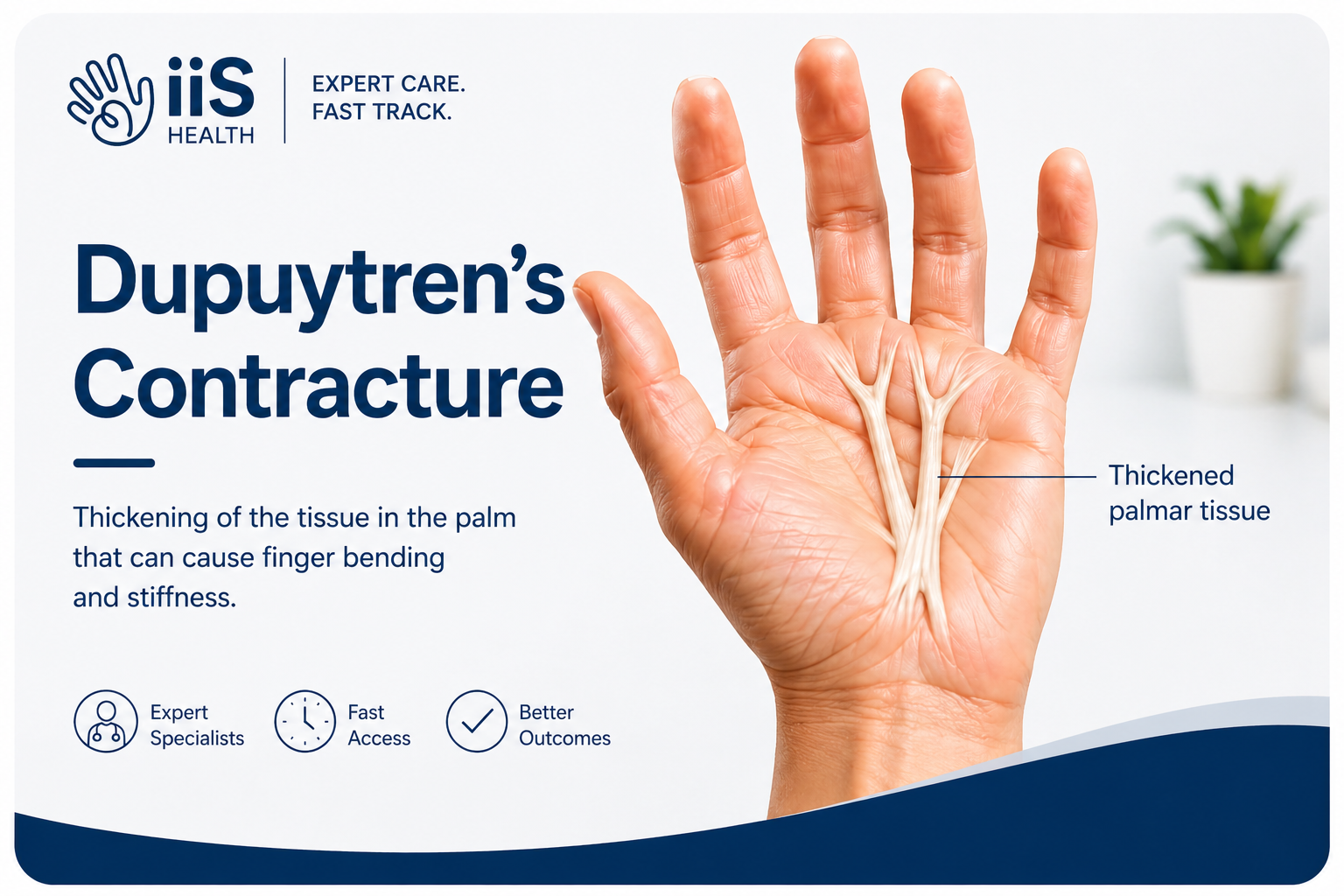
Dupuytren’s disease is the thickening, with subsequent shortening, of the layer beneath the skin known as the fascia.
The fascia is a structural layer that protects the underlying nerves and blood vessels, while also attaching to the overlying skin to provide stability. This condition is often misunderstood to be a problem affecting the tendons; however, the tendons lie beneath the fascia and are not involved in the disease process.
Over time, this thickening can form cords that extend into the fingers, gradually pulling them towards the palm and making it difficult or impossible to fully straighten them.
The exact cause of Dupuytren’s disease is not fully understood, but several associations are recognised:
• More common in individuals of Northern European descent
• Can run in families (genetic predisposition)
• Associated with diabetes
• Linked with excessive alcohol consumption
• Associated with epilepsy
• More commonly affects men than women
Symptoms typically progress gradually and may include:
• Nodules – Small lumps or bumps in the palm, often the first sign
• Cords – Thickened bands of tissue developing in the palm
• Contracture – Fingers being pulled towards the palm
Additional features may include:
• Difficulty straightening the fingers
• Problems with everyday tasks such as washing, wearing gloves, or shaking hands
• Most commonly affects the ring and little fingers
In more advanced cases:
• Thickened tissue may appear over the back of finger joints (Garrod’s pads)
• Similar conditions may affect the feet (Ledderhose disease)
• In men, it may affect the penis (Peyronie’s disease)
Diagnosis is usually made through a detailed clinical history and examination of the hand.
It is uncommon for additional investigations or imaging to be required.
There is currently no cure for Dupuytren’s disease. Treatment is focused on improving hand function and correcting finger position.
Management depends on severity:
• Mild cases with no progression may not require treatment
• Progressive or severe deformities may require intervention
Available options include:
• Collagenase injection – Weakens the cords to allow finger straightening (currently unavailable in the UK due to supply issues)
• Needle fasciotomy – Minimally invasive release of the cord using a needle under local anaesthetic
• Surgical treatment – Recommended for more severe or progressive cases
Surgery aims to remove the diseased fascia to allow the fingers to straighten.
• Performed as a day case under general anaesthetic
• Duration ranges from 30 minutes to 2 hours depending on severity
• In more severe cases, a dermofasciectomy may be required (removal of skin and fascia)
• Skin grafting from the forearm may be necessary in complex or recurrent cases
Following surgery:
• A bulky dressing is applied initially
• The wound is checked at 48 hours
• Stitches are removed at approximately 10 days
Rehabilitation includes:
• Early review by a hand therapist
• A custom-made splint worn at night for up to 4 months
• This helps prevent the finger from bending again while the scar matures
Return to work:
• Office-based work – approximately 2 weeks
• Manual work – up to 6 weeks
• Full strength recovery may take up to 3 months
Driving:
• Not recommended until stitches have been removed (around 10 days)
Return to sport:
• Most activities – around 6 weeks
• More physically demanding sports – up to 3 months
As with any surgery, there are potential risks:
• Infection (around 1%), usually treated with antibiotics
• Swelling and stiffness, which may take several months to settle
• Scar sensitivity, particularly in the palm, which improves with time and massage
• Nerve injury (rare), which may result in numbness in part of the finger
Recurrence is a recognised feature of Dupuytren’s disease, as there is no cure for the underlying process.
• Patients treated later in life are less likely to need repeat surgery
• The condition may affect other fingers or the opposite hand
• Surgery for recurrence is possible but often more complex
• Complex Regional Pain Syndrome (CRPS) is a very rare complication (~1%)
This can cause prolonged pain, swelling and sensitivity in the hand.
It usually improves with time but can take several months.
You should seek medical advice if you notice:
• Lumps or thickening in the palm
• Difficulty straightening your fingers
• Progressive bending of the fingers
• Symptoms affecting daily activities
Early assessment allows for monitoring and timely treatment where required.




.png)