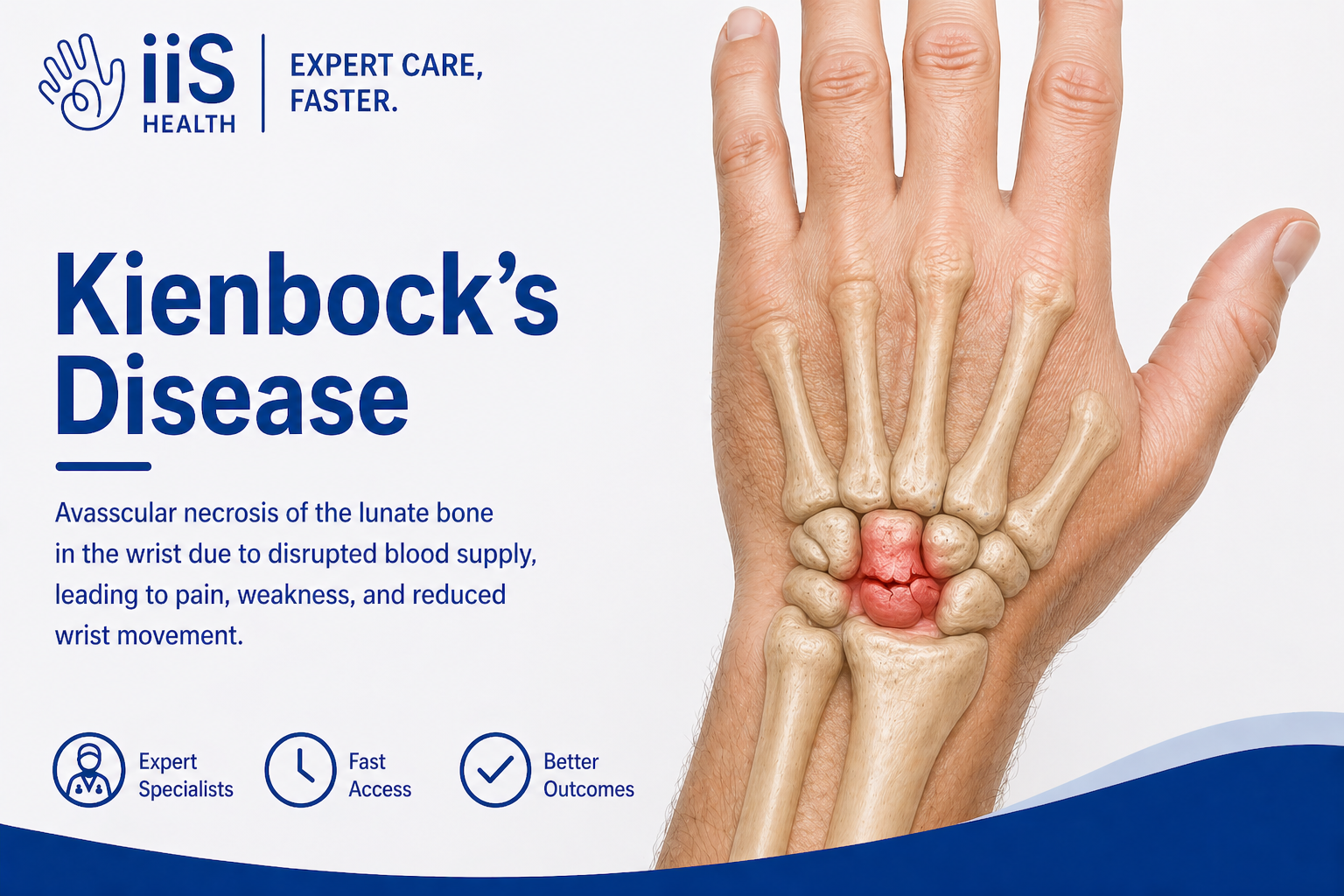
Kienböck’s disease is a rare condition in which the blood supply to the lunate bone in the wrist is reduced or lost.
This leads to avascular necrosis (bone death), which may affect part or all of the lunate. Over time, this can result in collapse of the bone and the development of arthritis within the wrist joint.
The condition is most commonly seen in men between the ages of 20 and 40.
The exact cause of Kienböck’s disease is not fully understood.
Several factors may contribute, including:
• Variations in the blood supply to the lunate
• Differences in bone shape or structure
• Reduced branching of blood vessels within the bone
• A relatively short ulna, increasing load through the lunate
These factors may lead to increased stress on the bone and disruption of its blood supply.
• Pain on the back of the wrist, particularly with activity
• Swelling of the wrist
• Stiffness and reduced movement
• Weakness and reduced grip strength
• Pain that may travel up the forearm
Symptoms often begin gradually and may initially resemble a wrist sprain. Over time, pain may become constant and occur even at rest.
Diagnosis is based on clinical history and examination.
Investigations include:
• X-rays of the wrist
• MRI scans in early or unclear cases to detect changes in bone blood supply
MRI is particularly useful in the early stages when X-rays may appear normal.
Treatment depends on the stage of the disease at presentation.
Non-surgical treatment:
• Immobilisation in a cast or splint
• Pain relief medication
Surgical treatment falls into three main categories:
• Revascularisation – restoring blood supply using bone grafts
• Load reduction – reducing pressure on the lunate by shortening surrounding bones
• Salvage procedures – used in advanced stages where arthritis is present
The choice of treatment is guided by disease stage, symptoms, and patient factors.
Surgical management depends on the stage of the disease:
Early stages:
• Bone grafting (often vascularised) to restore blood supply
Intermediate stages:
• Procedures to reduce load on the lunate, such as shortening the radius
• Bone grafting may still be considered
Advanced stages:
• Removal of the lunate, sometimes combined with partial wrist fusion
• Removal of multiple carpal bones in selected cases
Late-stage disease (with arthritis):
• Wrist fusion for reliable pain relief
• Wrist replacement in selected patients
• Wrist denervation to reduce pain in certain cases
The most appropriate procedure will be discussed in detail during consultation.
After treatment:
• Immobilisation in a cast or splint is usually required
• Duration depends on the procedure performed
Return to work:
• Depends on the type of surgery and job demands
Driving:
• Usually only possible once out of cast
• May take additional time to regain comfort and control
Rehabilitation:
• Physiotherapy may be required to restore movement and strength
As with any condition or surgery, there are potential risks:
• Persistent pain or stiffness
• Progression of the disease despite treatment
• Development of wrist arthritis
• Reduced range of motion
Surgical risks include:
• Infection (around 1%)
• Swelling and stiffness
• Nerve irritation or injury (rare)
• Complex Regional Pain Syndrome (CRPS), a rare complication causing prolonged pain and sensitivity
You should seek medical advice if:
• You have persistent wrist pain without a clear cause
• Pain does not improve after a suspected sprain
• You notice increasing stiffness or weakness
• Symptoms are worsening over time
Early diagnosis improves the range of treatment options available.




.png)