
Imagine trying to type a simple email or grip your morning kettle, only for your finger to painfully lock in place, requiring you to physically pry it open with your other hand. For the 2% of the UK population living with this condition, these moments of "catching" aren't just frustrating; they're a constant reminder of lost freedom. You've likely spent weeks wondering if a steroid injection will be enough or if a trigger finger release is the only way to truly fix the problem. It's completely natural to feel anxious about surgery or confused by conflicting advice when your livelihood depends on your hands.
At iiS Health, we understand that you're not just another patient on a waiting list; you're someone who deserves to live without physical limitations. We've designed this guide to help you discover the clear differences between surgical and non-surgical treatments, ensuring you have the expert knowledge to make the right choice for your lifestyle. We'll explore the bespoke recovery process and how our specialist approach achieves a 98% success rate in restoring seamless, pain-free movement. From your initial consultation to your final follow-up, we're here to ensure your journey back to full function is smooth, supported, and entirely under one roof.
• Understand the mechanical cause of your hand pain and how inflammation within the A1 pulley sheath leads to that frustrating 'locking' sensation.
• Compare the precision of open surgery against percutaneous trigger finger release to find the most effective path for restoring your hand's seamless movement.
• Evaluate the long-term success rates of surgical intervention versus steroid injections to make an informed decision about your clinical care and lasting recovery.
• Explore your complete patient journey, ensuring a smooth transition from your initial bespoke assessment through to specialist hand therapy.
• Discover how to bypass lengthy waiting lists and access expert orthopaedic and plastic surgeons under one roof for a faster, stress-free return to health.
If you've ever felt your finger catch or snap painfully when trying to straighten it, you're likely experiencing Stenosing Tenosynovitis. This condition occurs when a mismatch develops between the flexor tendon and the A1 pulley sheath. Think of it as a rope that has become frayed or swollen, making it difficult to glide through a narrow tunnel. While any digit can be affected, the thumb and ring finger are involved in approximately 63% of clinical cases due to the high mechanical loads they handle during daily gripping tasks. You aren't just dealing with a minor annoyance; the inflammation and thickening of the tendon sheath create a physical blockage that disrupts your hand's natural harmony. When this 'locking' sensation becomes frequent, it's a sign that the space within the sheath has narrowed significantly.
We typically suggest surgical intervention when conservative methods, like splinting or steroid injections, fail to provide lasting relief after six months. If your finger is frequently locking or remains stuck in a flexed position, it's time to consider a more permanent solution. Patients with underlying conditions like diabetes face a 10% higher risk of developing this condition, and they often find that non-surgical options are less effective. Trigger finger release is a surgical procedure to widen the tendon sheath for smoother movement. At iiS Health, we provide expert care without the wait, ensuring you get back to your routine with a bespoke treatment plan. You’re not just another patient; your comfort and mobility are our primary focus.
Visualising the 'tunnel and rope' analogy helps explain why the pain occurs. Repetitive strain or sudden trauma often leads to the formation of a small nodule on the tendon. This lump gets caught at the entrance of the A1 pulley, which is the first of several 'tunnels' holding the tendon against the bone. By performing a trigger finger release, our specialists surgically divide this pulley to create more space. This simple action provides immediate mechanical relief because the 'tunnel' is no longer too tight for the 'rope' to pass through. You'll often notice the difference in mobility almost instantly. We provide these advanced treatments under one roof, ensuring a seamless transition from your first consultation to your final recovery session.
Our approach combines clinical authority with a personal touch. We understand that hand pain can be frustrating, which is why we prioritise a direct, problem-solution path. By choosing trigger finger release at a specialised facility, you eliminate the stress of long waiting lists and confusing referrals. Our goal is to provide a smooth, hospital-standard experience in a boutique environment where you feel heard and supported throughout the entire process.
Choosing the right path for your trigger finger release depends on your specific symptoms and hand anatomy. Most patients at our clinic undergo these procedures under a local anaesthetic. This approach ensures you remain comfortable and pain-free while staying awake, allowing for a seamless day-case experience. You won't need a heavy general anaesthetic, which means your recovery starts the moment you leave the theatre. We focus on making the process as smooth as possible, moving you from diagnosis to relief without the frustration of long hospital stays.
The open release is widely considered the gold standard for surgical treatment. Your surgeon makes a precise incision, usually 1 to 2 centimetres long, in the palm of your hand. This opening allows for direct visualisation of the A1 pulley, the tissue causing the tendon to catch. By seeing the anatomy clearly, the surgeon can safely divide the pulley while protecting the nearby digital nerves.
A vital part of this technique is the "active test." Because you're under local anaesthetic, your surgeon will ask you to move your finger during the procedure. This confirms the release is 100% complete before the skin is closed. This direct confirmation contributes to a 97% long-term success rate, making it the preferred choice for complex cases or fingers with significant scarring. For a deeper look at why this pulley causes issues, Understanding Trigger Finger anatomy is a helpful starting point for your journey.
Percutaneous release offers a different approach, using a needle to "niche" the pulley through the skin without a large incision. It's a quick technique that often results in less immediate post-operative tenderness. However, it's not suitable for everyone. Clinical data indicates this method is less effective for the thumb or for patients with severe joint contractures where the anatomy is less predictable.
While the infection rate for both methods is low, typically affecting fewer than 1 in 100 patients, the percutaneous method carries a slightly higher risk of incomplete release because the surgeon cannot see the tendon directly. If you're looking for a fast return to light tasks, this might be an option, but we often recommend the open technique for its unmatched precision. If you're unsure which path is right for your hand health, our specialists provide bespoke consultations to help you decide on the safest, most effective treatment.
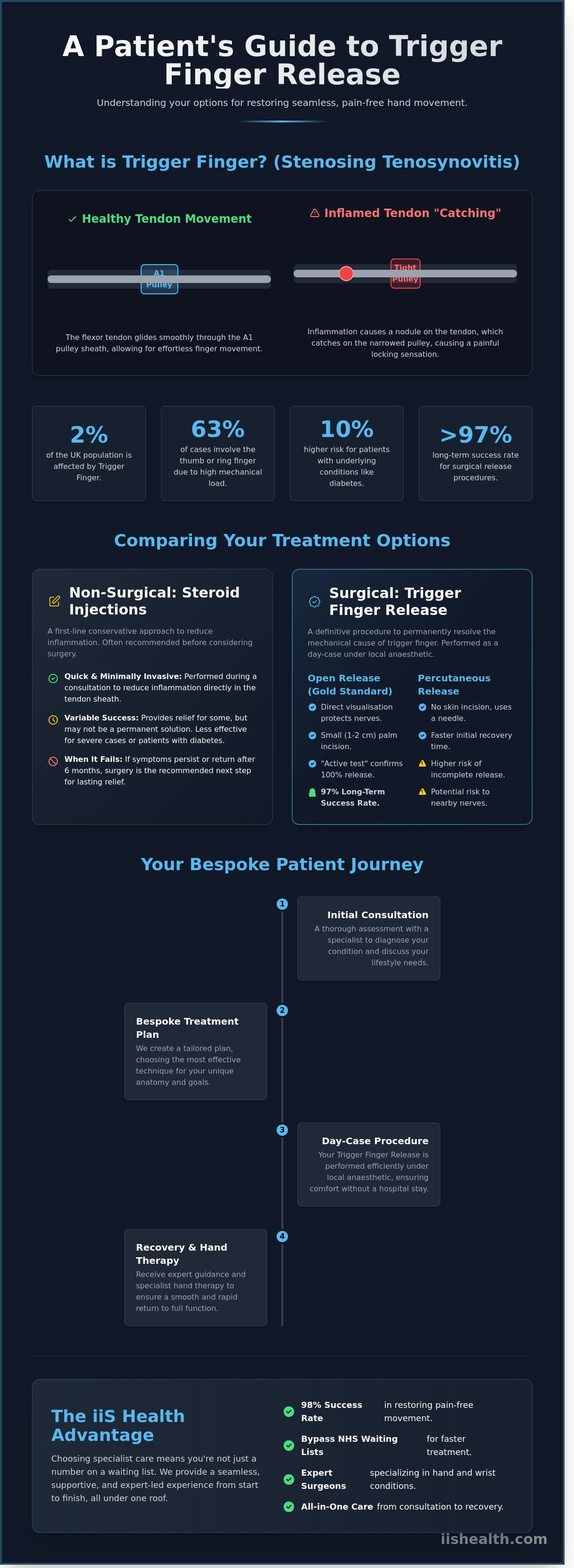
Deciding between a temporary fix and a permanent solution is a pivotal moment in your recovery. Many patients arrive at our clinic feeling trapped in a cycle of recurring pain and frustration. While initial treatments focus on managing symptoms, understanding the long-term data helps you make an informed choice for your hand health. You deserve a clear path forward that prioritises your comfort and long-term mobility.
The choice often boils down to the severity of your symptoms and how long you've been experiencing them. Statistics show that while conservative measures work for some, chronic cases require a more decisive approach to prevent lasting damage. We balance the clinical evidence with your personal goals to find the right fit.
Corticosteroid injections act as a powerful anti-inflammatory tool. They work by shrinking the swollen tendon sheath, which allows the digit to glide without catching. For mild, early-stage cases, this approach offers a success rate between 50% and 70%. However, these results aren't always permanent. Some patients experience localised skin thinning or fat atrophy at the injection site. If you have diabetes, you might notice temporary blood sugar spikes for up to 48 hours post-treatment.
We usually recommend a maximum of two injections before considering other options. If the clicking returns after a second dose, continuing with needles often delays the inevitable and increases the risk of permanent joint stiffness. For a deeper look at the clinical management of trigger finger, medical literature highlights how these non-surgical routes compare to definitive interventions in terms of long-term patient outcomes.
While injections treat the inflammation, a trigger finger release addresses the actual mechanical blockage. Surgery involves a small, precise incision to release the A1 pulley. This provides a near-permanent fix with a success rate exceeding 97% in most clinical studies. It's frequently the most cost-effective path for chronic sufferers because it eliminates the need for ongoing appointments and repeat prescriptions.
At iiS Health, we often use steroid injections as a useful diagnostic step. If the steroid provides even temporary relief, it confirms that a surgical release will likely be highly effective for your specific anatomy. Data shows that patient satisfaction scores are significantly higher for those who choose a trigger finger release early rather than adopting a "wait and see" approach that lasts for years. We focus on getting you back to your daily routine with a bespoke recovery plan that ensures your hand feels like yours again.
Best for first-time symptoms or mild catching.
Recommended for recurring triggers or fingers stuck in a bent position.
Waiting too long can lead to fixed joint contractures that are harder to treat later.
Your path to restored mobility begins with a detailed pre-operative assessment. Our specialists don't just look at your finger; they evaluate your entire hand and wrist health to ensure a trigger finger release is the most effective solution for your specific symptoms. This bespoke approach means we consider your occupation, hobbies, and medical history before creating a surgical plan. You'll receive clear instructions on how to prepare, ensuring you feel confident and informed before you even step into our clinic.
On the day of your procedure, you'll experience a specialist clinical environment designed for comfort rather than the cold atmosphere of a traditional hospital. The surgery is typically performed under local anaesthetic, meaning you're awake but won't feel any pain. It's a streamlined process that usually takes less than 20 minutes. Because we prioritise efficiency, you'll find there are no endless waiting rooms or confusing referrals. You're treated as an individual, receiving expert care without the wait.
You'll leave the clinic with a protective dressing. It's vital to keep your hand elevated above your heart level to reduce swelling. You should begin gentle "tendon glide" exercises immediately to keep the finger moving.
Most patients return to light office work within 3 to 5 days post-surgery. Around day 10 to 14, a clinician will remove your sutures. You'll notice a significant reduction in "locking" sensations, allowing you to transition back to light daily activities like typing or driving.
By this stage, the internal tissues have reached a 90% healing threshold. You can typically return to heavy lifting, gym sessions, or demanding professional tasks. We monitor your progress closely to ensure your grip strength is returning to its pre-condition levels.
Success doesn't end when the stitches come out. Specialist hand therapists play a vital role in your long-term outcome by preventing scar tissue adhesion, which can sometimes restrict movement if left unmanaged. They'll guide you through a customised exercise programme to restore full grip strength and fine motor skills. Clinical data from the British Society for Surgery of the Hand suggests a 97% long-term success rate when surgery is paired with proactive rehabilitation. We provide all these services under one roof, ensuring your recovery is seamless and supported by a team that knows your history.
Ready to regain full use of your hand? Book your specialist assessment today and experience expert care without the wait.
Choosing where to have your trigger finger release is a decision that impacts your long-term mobility and quality of life. At iiS Health, we've moved away from the fragmented hospital model to create a streamlined experience. We bring expert orthopaedic and plastic surgeons together with specialist hand therapists under one roof. This integrated approach ensures your care is a continuous, coordinated journey toward recovery rather than a series of disconnected appointments. Our commitment to minimally invasive techniques means smaller incisions and less post-operative discomfort, allowing you to return to your routine faster.
In the UK, waiting lists for elective hand surgery can often exceed 26 weeks in certain NHS trusts, leaving patients in persistent pain. We prioritise rapid diagnosis because we know that delay can lead to permanent joint stiffness or secondary tendon damage. Unlike a general hospital, our dedicated hand and wrist facility focuses entirely on your upper limb health. We've streamlined our referral processes so you can access diagnostic imaging, including high-resolution ultrasound or MRI, within 48 to 72 hours. You won't face the frustration of endless waiting or confusing referrals; you'll get the clarity you need immediately.
We understand that your hands are your livelihood. Whether you're a professional musician, a competitive athlete, or someone who relies on precise motor skills for work, our bespoke health plans reflect your specific demands. Our "Pragmatic Caregiver" approach combines clinical excellence with genuine empathy. We don't just treat the condition; we support the person. Our team specialises in trigger finger release procedures that account for the high-intensity needs of your profession. Specialist hand therapists work alongside your surgeon to create a rehabilitation programme that targets a full return to peak performance. You're not just another patient; you're an individual with a unique path to healing. Book your specialist consultation to start your journey to pain-free movement.
Persistent finger locking doesn't have to dictate your daily life. Whether you opt for a minimally invasive percutaneous procedure or a traditional trigger finger release, the primary goal is a seamless return to full function. Most patients return to light activities within 14 days, following a clear clinical pathway that bypasses the frustration of long waiting lists. You're not just another patient; you're an individual who deserves a treatment plan that respects your time and your specific recovery goals.
At iiS Health, we provide immediate access to a team of 12 expert orthopaedic and plastic surgeons. Our model brings everything under one roof, combining same-day surgical procedures with bespoke post-operative hand therapy plans tailored to your anatomy. We focus on removing the friction from healthcare by delivering clinical excellence in a supportive, specialist environment. It's about expert care without the wait, ensuring your path to healing is as smooth as possible.
Take the first step toward pain-free movement today. Start your journey to recovery with an expert hand consultation and rediscover your strength. We're ready to support you every step of the way.
You won't feel pain during the procedure because we use a local anaesthetic to completely numb the area. Most patients report 48 to 72 hours of mild soreness after the numbing wears off, which is easily managed with standard over-the-counter painkillers. Our surgical team focuses on your comfort throughout the process, ensuring a smooth experience from the moment you enter our clinic.
A standard trigger finger release procedure typically takes between 15 and 20 minutes to complete. It's performed as a day-case treatment, meaning you'll arrive, have your surgery, and return home all within a single morning or afternoon. We've streamlined our clinical pathway to ensure you receive expert care without the wait, getting you back to your daily routine as quickly as possible.
You can usually return to driving within 3 to 5 days once you've regained enough grip strength to control the vehicle safely. It's essential that you're no longer taking strong painkillers and feel confident performing an emergency stop. We recommend checking with your specific motor insurer before getting back behind the wheel to ensure your coverage remains fully active during your recovery.
It's very unlikely that the condition will return in the same finger, as the surgery has a 97% success rate according to British Society for Surgery of the Hand data. While the released tendon sheath won't tighten again, it's possible for other fingers to develop similar symptoms in the future. We provide a bespoke recovery plan to help you maintain hand health and prevent further issues.
The risks are very low, with infection rates occurring in fewer than 1% of cases. You might experience temporary stiffness or some scarring around the incision site, but these usually resolve with the hand exercises we provide. Serious complications, such as nerve damage, affect less than 1 in 100 patients. Our specialist surgeons use advanced techniques to minimise these risks and ensure your safety.
Yes, we can treat multiple fingers during a single session to save you time and consolidate your recovery period. Treating two or three fingers at once is a common request that allows us to provide a more efficient, seamless experience. We'll discuss the practicalities of managing your daily tasks during your initial consultation to ensure you're fully prepared for the short healing phase.
You don't need a GP referral to book a consultation with our specialist hand surgeons at iiS Health. We believe in providing direct access to expert care, so you can skip the traditional healthcare frustrations and see a consultant immediately. Simply contact us to arrange a time that suits you. You're not just another patient; you're our priority from your first visit.
The cost for a private trigger finger release in the UK typically ranges from £1,800 to £2,600 per finger. This price includes your surgeon's fee, the clinical facility costs, and your initial follow-up appointments. At iiS Health, we provide transparent, fixed-price quotes with no hidden extras, ensuring you can plan your treatment with total financial confidence and peace of mind.









.png)