
Scaphoid fractures are one of the most commonly missed injuries in the wrist. They can also be one of the most problematic if not identified and treated early.
This is not because they are rare or particularly complex, but because of the way the bone is shaped, how it is seen on imaging, and how it heals.
The scaphoid is a small bone on the thumb side of the wrist with an irregular, curved shape.
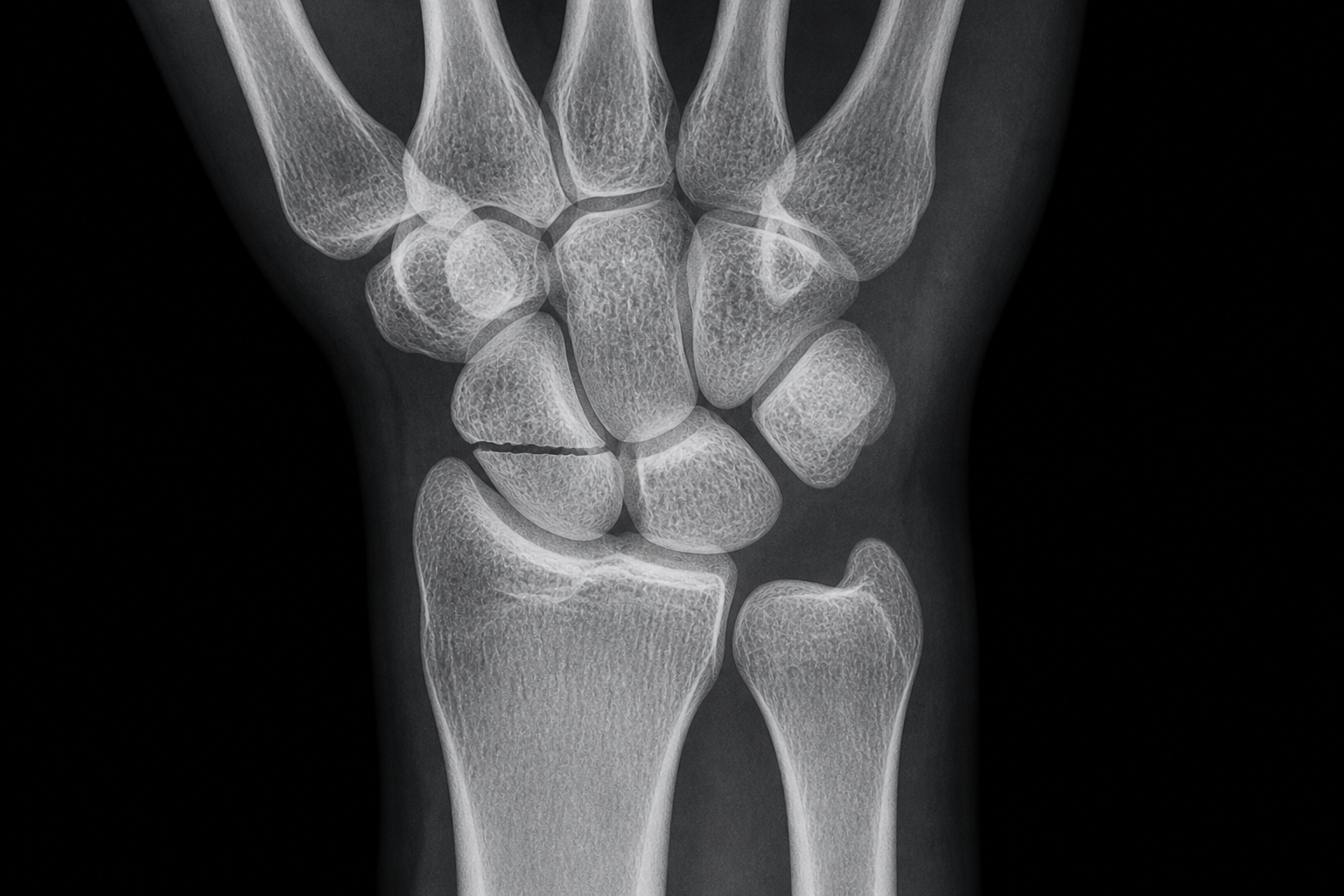
Because of this, a fracture may only be visible if the X-ray beam passes directly in line with the break. If the angle is slightly off, the fracture can be difficult to see or may not appear at all.
For this reason, multiple X-ray views are usually required when a scaphoid fracture is suspected. Even then, early fractures may still not be clearly visible.
This is why patients with ongoing pain after a wrist injury are sometimes treated as having a scaphoid injury, even if the initial X-rays are normal.
The scaphoid has a unique blood supply, which comes from the far end of the bone and travels back towards the part closest to the forearm. This is known as a retrograde blood supply.
As a result, the part of the bone nearest the forearm has a more limited blood supply and is more vulnerable to problems with healing.
If a fracture disrupts this blood flow, the bone may heal slowly or not at all.
Unlike many other fractures, the scaphoid does not produce large amounts of new bone to bridge a gap between the broken ends.
Instead, healing relies on the two ends of the bone being well aligned and having a good blood supply. This type of healing requires stability and close contact between the fracture surfaces.
If the bone ends are not well aligned, or if there is movement at the fracture site, healing is less likely to occur.
When a scaphoid fracture is identified early and treated appropriately, the chances of successful healing are generally good.
However, if the injury is missed or treatment is delayed, the fracture may fail to heal. This is known as a scaphoid nonunion.
Over time, this can lead to ongoing pain, reduced wrist function, and eventually wear in the wrist joint (arthritis).
You should seek further medical advice if you have ongoing pain on the thumb side of your wrist following an injury, particularly if symptoms are not improving.
In some cases, additional imaging such as an MRI or CT scan may be needed to confirm the diagnosis and guide treatment.
Scaphoid fractures are often missed because of the shape of the bone and the limitations of standard X-rays.
Their blood supply and method of healing also make them more prone to delayed healing or nonunion.
Early assessment and appropriate management are important to reduce the risk of long-term problems and to maintain good wrist function.








.png)