
Base of thumb arthritis is one of the most common causes of hand pain in adults, and one of the most quietly disruptive. It rarely announces itself suddenly — instead, it builds gradually over years, as everyday tasks like opening a jar, turning a key, or gripping a pen slowly become harder, until a patient realises they have been avoiding or working around a problem for far longer than they first thought.
This article covers what is actually happening at the base of the thumb, the evidence behind the full range of treatment — from hand therapy through to the two main surgical options, including thumb joint replacement — and where the genuine trade-offs lie between them.
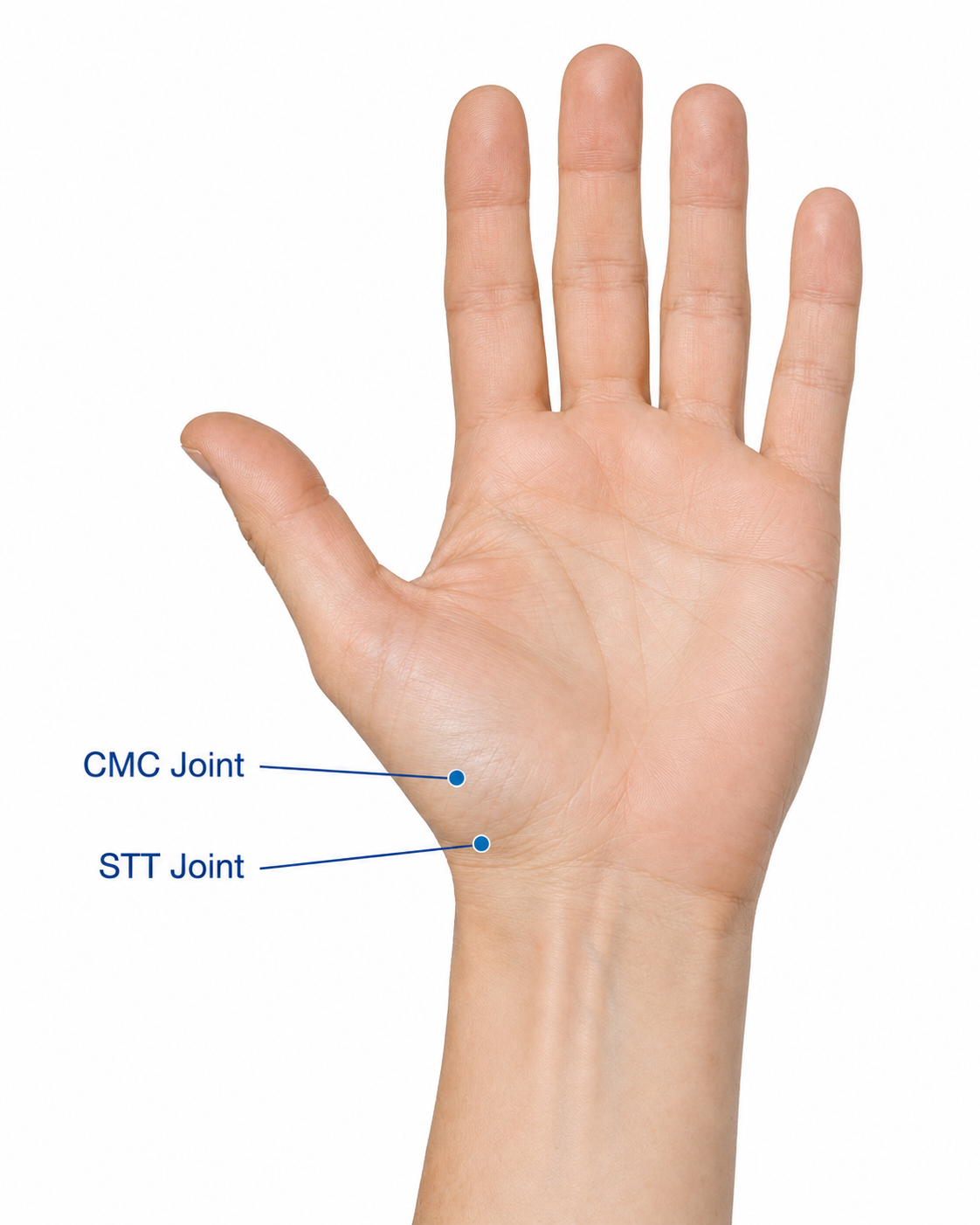
Base of thumb arthritis usually refers to arthritis of the carpometacarpal (CMC) joint — the joint between the trapezium bone and the metacarpal bone of the thumb — though a related joint, the scaphotrapeziotrapezoid (STT) joint, sitting between the CMC joint and the wrist, can also be affected, either instead of or alongside the CMC joint.
In a healthy joint, the ends of the bones are covered by articular cartilage: a smooth, protective layer with no nerve supply of its own, which allows pain-free movement. Over time, this cartilage thins and wears away — sometimes simply through natural wear, sometimes accelerated by an excess of enzymes that break cartilage down. Once the cartilage is gone, the underlying bone — which does have a nerve supply — becomes exposed, and this is what generates the pain of osteoarthritis.
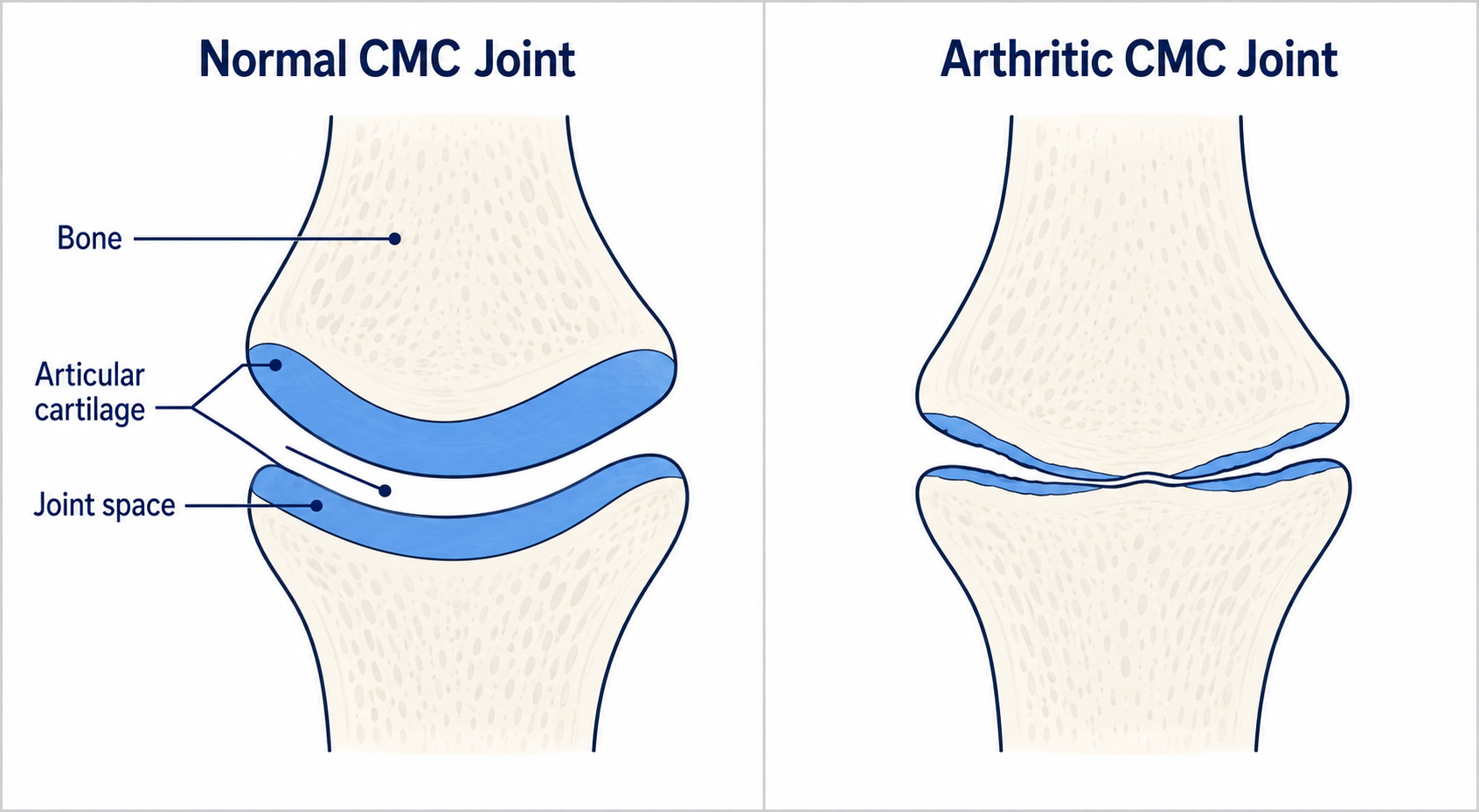
The CMC joint has a particularly wide range of motion, held together by a set of strong ligaments — a combination that gives the thumb its exceptional mobility, at the cost of relying heavily on those ligaments for stability.1 Exactly which comes first — the cartilage wearing out, or the ligaments stretching — is not fully settled, but the practical result is the same: the ligaments loosen, and the base of the thumb metacarpal gradually drifts outward, away from the palm and toward the outer edge of the hand (in medical terms, this is described as moving "radially"), out of its normal alignment with the trapezium. This is what produces the visible "bump" many patients notice at the base of the thumb — not a new lump, but the bone itself sitting in a different position than before.
As this drift progresses, the body compensates. To keep the thumb pad usable for pinching, the knuckle joint further along the thumb (the MCP joint) bends backward — a deformity called hyperextension, or a collapse deformity — which keeps the thumb functional even as the base joint deteriorates significantly. This compensation is a major reason base of thumb arthritis can become quite advanced before a patient realises how serious it has become: the body quietly adapts, long before the patient consciously notices.
CMC joint arthritis affects women considerably more than men — radiographic studies show roughly six times the rate in women compared with men — and typically presents from the mid-fifties onward, most commonly from the mid-sixties.1 The reason for this striking sex difference has become clearer in recent research: a study published in *Clinical Orthopaedics and Related Research* identified a hormone called relaxin, which peaks during the menstrual cycle and promotes the breakdown of collagen in the ligaments supporting the thumb, and found a significant correlation between serum relaxin and the enzymes that break down ligament tissue — offering a plausible biological explanation for why this condition disproportionately affects women, though the authors themselves note further research is needed.2
Men do develop CMC arthritis, generally somewhat later, and it is disproportionately seen in those with physically demanding occupations — manual trades involving repeated, forceful gripping and pinching.
STT joint arthritis, where the STT joint is affected more than the CMC joint, appears to follow a different pattern clinically, and can occur alongside wrist arthritis, which makes distinguishing between the two clinically important, since the treatment approach differs.
Two smaller groups are also worth recognising: patients with longstanding, inadequately treated inflammatory arthritis (such as rheumatoid arthritis) can develop significant base of thumb arthritis at a younger age than typical; and patients with generalised joint hyperlaxity — unusually flexible, loose joints — may wear out the CMC joint prematurely, a pattern seen more often in women.
Because base of thumb arthritis develops so gradually, patients rarely present early. Instead, symptoms accumulate quietly for years — an ache here, a twinge there — until a specific task becomes genuinely difficult: opening a bag of crisps, using scissors, turning a key, lifting something from the oven. Often it is not the patient but a partner or family member who ends up opening jars, which is frequently the moment that prompts a visit.
On examination, a recognisable sign is "squaring" at the base of the thumb — the joint takes on a squared-off appearance rather than a smooth curve, as the metacarpal drifts out of position. Tenderness is usually present directly over the CMC joint, and sometimes over the STT joint as well. In more advanced cases, the hyperextension deformity at the thumb's knuckle joint described above becomes visible.
X-ray is used to confirm the diagnosis and establish two things: how advanced the wear is (whether the bones are touching directly, bone-on-bone), and — importantly — whether the arthritis is confined to the CMC joint, the STT joint, or both, since this affects which treatment is most appropriate.
Arthritis is not a life-threatening condition, and as long as symptoms are manageable, there is no need to rush toward anything more invasive. The first-line approach for the great majority of patients is hand therapy — and this is frequently underestimated by patients who assume it simply means a splint and some stretches.
Good hand therapy, delivered by therapists with an occupational therapy background, looks much more broadly at how the condition affects daily life, and finds practical ways around it: adapted grips for jars, larger-diameter pens that reduce the pinch force needed for writing, and similar adjustments tailored to what a particular patient actually struggles with. Done well, this can keep many patients comfortable and functional for years without ever needing an injection or an operation.
Where hand therapy alone is not enough, a steroid injection into the CMC joint is a reasonable next step, and can provide meaningful pain relief — sometimes for as long as a year, though the duration varies considerably between patients.
Injections have a second, genuinely useful role beyond pain relief: as a diagnostic and prognostic tool. In patients with arthritis in multiple joints of the hand, injecting the CMC joint specifically and finding it relieves the great majority of the pain confirms that the base of the thumb, rather than the smaller finger joints, is the main driver of symptoms — which focuses any further treatment where it will actually help. The duration of relief also carries useful information: a patient who gets 18 months of relief from a single injection is clearly not yet at the point of needing surgery, whereas a patient whose relief lasts only two weeks is likely heading toward it before long.
For STT joint arthritis specifically, injections tend to only temporise the problem rather than offer a lasting solution. That said, "temporising" can still be genuinely valuable in the right circumstances — for either joint — for example, in a patient nearing retirement who mainly needs to manage symptoms for a limited period before the demands on their hands reduce.
There is also a biological alternative to steroid worth considering: platelet-rich plasma (PRP), a concentrate prepared from a patient's own blood. The rationale for considering it is worth stating plainly: while steroid injections are effective for pain relief, there is a genuine, documented concern in the literature that intra-articular steroids may contribute to further degeneration of already-damaged cartilage — in effect, treating the pain today at some cost to the joint itself.3 PRP carries no such concern, since it introduces nothing that breaks tissue down.
The evidence for PRP in thumb base arthritis specifically is still limited, but genuinely promising rather than merely theoretical. A randomised controlled trial of 33 patients comparing PRP against steroid injection found significantly better pain scores and patient satisfaction in the PRP group at 12 months, with the authors concluding PRP may offer a lasting effect of up to a year in early-to-moderate thumb base arthritis.4 It is worth noting that the PRP used in this trial was prepared manually at a hospital laboratory rather than via a standardised commercial device, so the platelet concentration achieved may not directly correspond to that produced by any specific commercial PRP system used in clinical practice today. Larger, well-designed trials using standardised preparation methods are still needed before PRP can be considered a proven first-line alternative to steroid, but for patients who would prefer to avoid a treatment with a theoretical cartilage-damaging effect, it represents a reasonable, low-risk option worth discussing.
Once hand therapy and injections have been tried and the condition is still meaningfully affecting daily life, surgery becomes the next reasonable step. There are two established approaches.
Trapeziectomy involves removing the trapezium bone entirely, so the two arthritic surfaces are no longer in contact. This can be done alone, or supplemented with a ligament reconstruction and tendon interposition (LRTI), using a tendon taken from the wrist to help stabilise the space left behind. A landmark randomised trial comparing trapeziectomy alone against trapeziectomy with tendon interposition and trapeziectomy with ligament reconstruction, in 76 women, found the three approaches produced indistinguishable results for pain relief, hand function and thumb strength at both three months and one year.5 In other words, the evidence does not clearly favour adding tendon or ligament reconstruction over removing the trapezium alone — though for patients with combined CMC and STT arthritis, trapeziectomy remains the best available surgical option.
CMC joint replacement (arthroplasty) removes the arthritic joint and replaces it with an artificial one, in much the same conceptual way as a hip or knee replacement. Early implants, introduced roughly 40 to 50 years ago, had a poor track record and fell out of favour for a long time as a result. Modern implant designs have changed this picture substantially, though the strength of the evidence differs depending on the specific design. Single-mobility implants — where a single ball moves within a single socket — have the longest track record: current-generation single-mobility designs report 10-year survival rates of around 92–95%, figures that compare favourably with the 10-year benchmarks used for hip replacement surgery.6 Newer dual-mobility designs add a second moving surface specifically to reduce the risk of the implant dislocating — a genuine of single-mobility designs, which carry a dislocation risk of around 5–8%. Early results for dual-mobility implants are excellent, with survival rates around 96–98% reported in several studies, and significantly fewer dislocations than single-mobility designs — but because these designs are newer, published follow-up is currently limited to the short-to-medium term, generally two to four years, rather than the decade-long data available for single-mobility implants.7 Functional recovery after joint replacement, of either design, is also meaningfully faster than trapeziectomy — Swedish national registry data found patients who had joint replacement took a mean of roughly 94 to 109 days of sick leave, compared with around a year for many patients to reach a good outcome after trapeziectomy.6 The genuine trade-off with any joint replacement is longevity: because even the longest-studied modern implants have not yet been in widespread use for multiple decades, it is not yet possible to say with certainty how they perform at 20 or 30 years, in the way that hip replacement outcomes are now well understood over that timeframe — and this uncertainty is naturally greater still for the newer dual-mobility designs. CMC joint replacement is available at iiS Health.
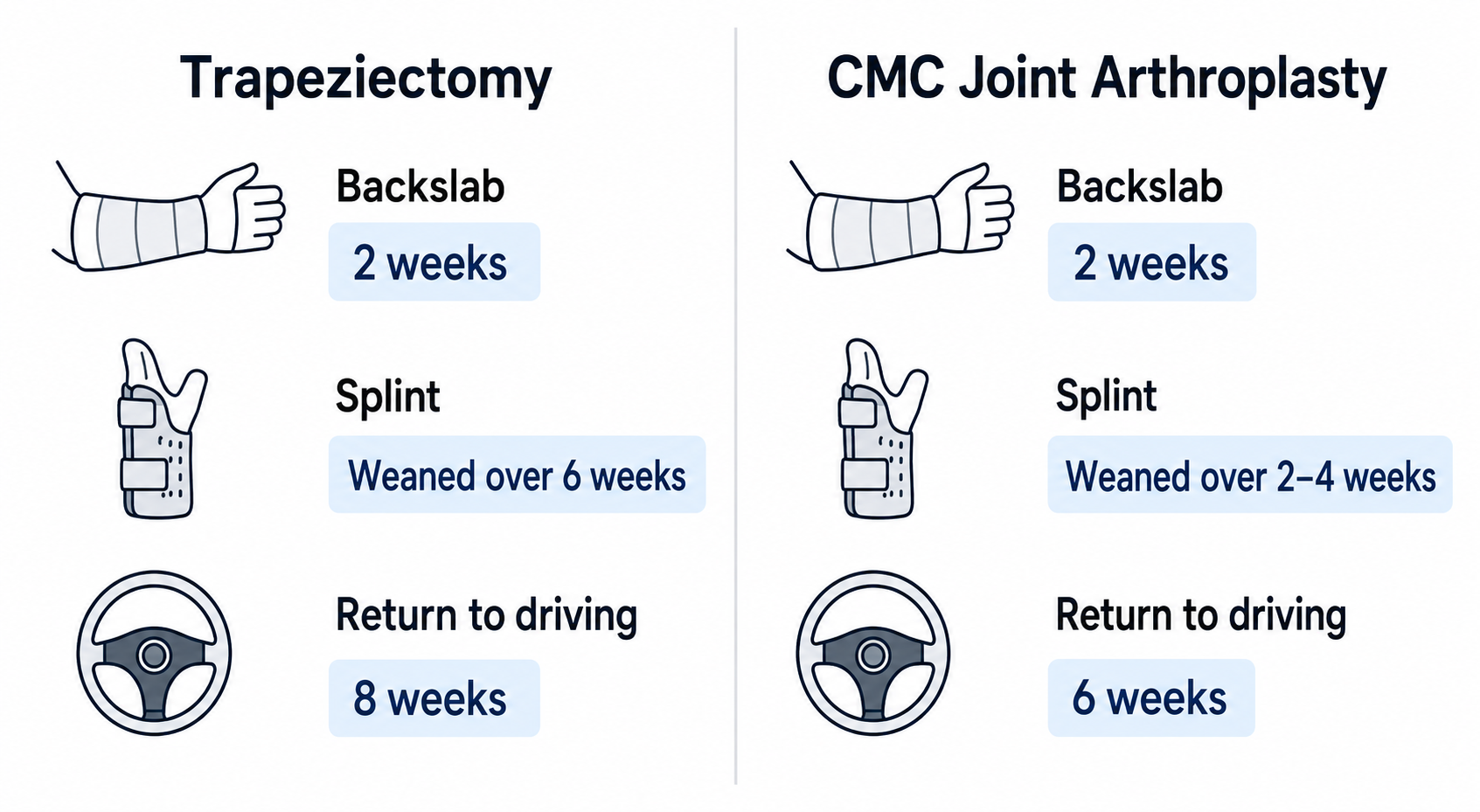
After trapeziectomy: patients are typically placed in a rigid backslab for the first two weeks, followed by a removable splint worn progressively less over the following six weeks, with most patients weaned off it by around eight weeks. Driving is generally possible from around eight weeks, though this varies — some patients manage sooner, from three to four weeks, particularly where swelling has been well controlled. Keeping the arm elevated in a sling for at least the first two weeks to minimise swelling makes a genuine difference to how quickly recovery progresses.
After joint replacement: recovery is generally faster, with driving often possible from around six weeks. As with trapeziectomy, controlling swelling early on with a sling makes a noticeable difference to overall recovery speed.
Most surgeons will not operate within three to six months of a steroid injection into the same joint, given concerns about infection risk and tissue healing. In practice, this window tends to be shorter — around three months — before a trapeziectomy, since nothing artificial is being introduced, and closer to six months before a joint replacement, given a foreign implant is involved. It is worth being transparent about the strength of the evidence behind this specific timeframe: it is a widely followed convention rather than something with a clearly established evidence base pinpointing six months as the correct cut-off, and it broadly reflects the standard clinical intervals (six weeks, twelve weeks, three months) more than a study-specific finding.
"Nothing can be done about arthritis." This is simply not true, and is one of the most common — and most limiting — misconceptions patients bring with them. Some patients spend years quietly giving up activities they enjoy, believing there is no alternative, when in fact there is a clear, graduated pathway: hand therapy, injections where appropriate, and, when needed, surgery with a strong track record of restoring function.
"I'll never be able to use my hand properly again after surgery." For the great majority of patients, the opposite is true. Because grip and pinch strength are usually so significantly reduced by advanced arthritis beforehand, most patients end up with better functional strength after surgery than they had in the months leading up to it — surgery does not fix arthritis elsewhere in the hand, but for the base of thumb joint specifically, outcomes are generally very good.
If day-to-day tasks — opening jars, gripping cutlery, writing, driving — have quietly become difficult over time, this is worth assessing rather than working around indefinitely. iiS Health offers on-site X-ray assessment to confirm the diagnosis and its extent in a single visit, along with access to the full range of treatment, including CMC joint replacement.





.png)