
A ganglion cyst is a fluid-filled lump that most commonly appears on the back of the wrist, though it can also form on the palm side of the wrist or at the base of a finger. It is the most frequently encountered soft tissue lump in the hand, and for the great majority of patients who find one, the first and most useful piece of information is simply this: it is not cancer, and in most cases it does not need treatment at all.
That said, "leave it alone" is not always the right answer, and understanding why a ganglion forms, what actually happens with each treatment option, and where the genuine risks and recurrence rates lie helps make a more informed decision than reassurance alone can offer.
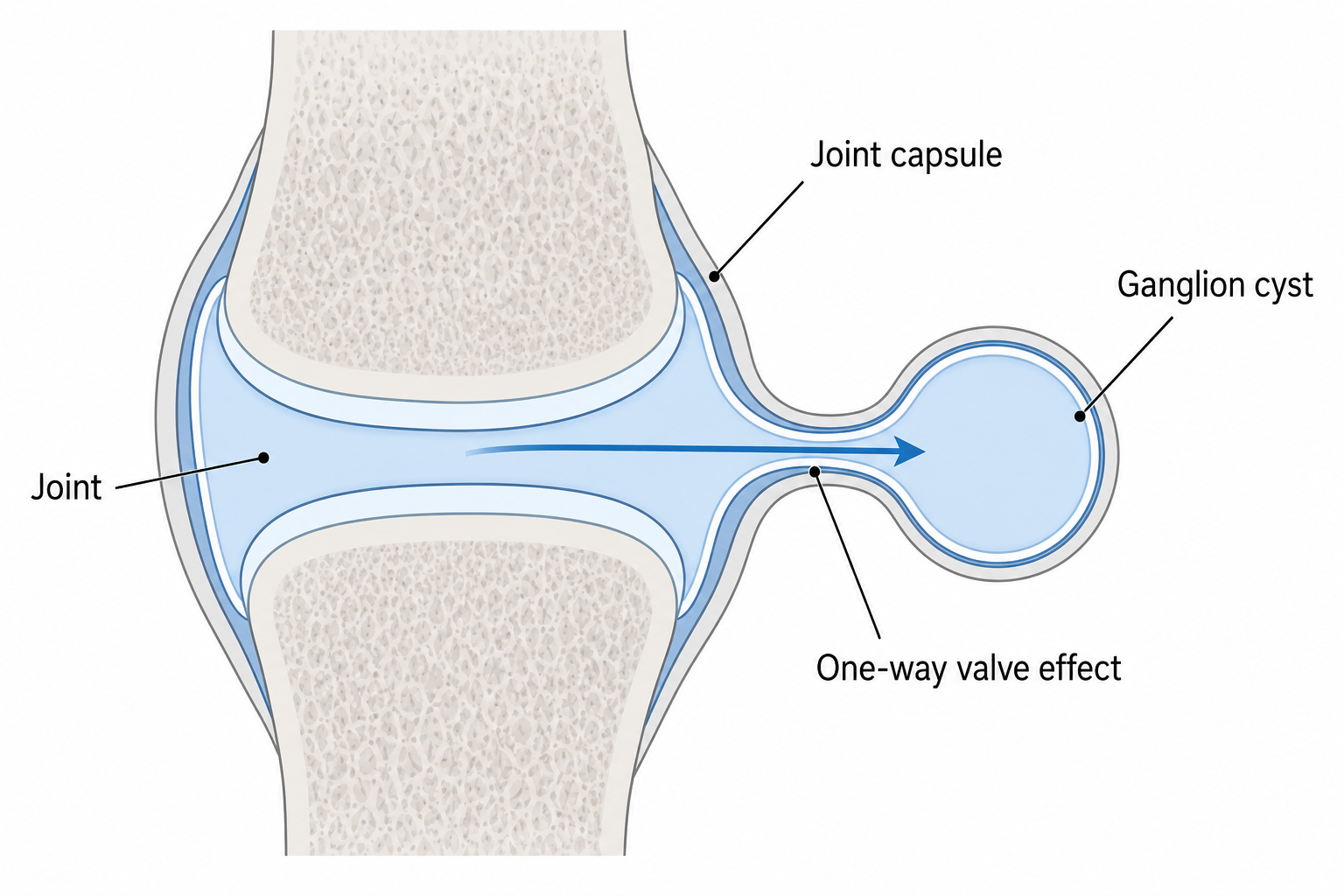
Each joint in the hand is enclosed by a capsule — a soft envelope of tissue containing the fluid that lubricates the joint surfaces as they move against each other. A ganglion cyst forms when part of this lining stretches, ballooning outward until it forms a distinct sac connected back to the joint by a narrow neck. Fluid from the joint can pass into this sac, but the connection tends to act as a one-way valve: fluid finds it easier to flow in than to flow back out, which is why the sac fills and persists rather than draining away on its own. This also explains why ganglion cysts often change size — sometimes appearing larger after activity, sometimes flattening or briefly disappearing — since the pressure and flow through that narrow connection is not constant.
The exact mechanism behind why the joint lining stretches in the first place is not known, though there are several hypotheses. Injury is often assumed to play a role, though many patients have no memory of any specific trauma. The "capsular stretch and one-way valve" explanation described above is the most widely accepted working model.1
Ganglion cysts are not one uniform presentation, and recognising which group a patient falls into helps guide the conversation from the first visit.
Wrist ganglia are the classic presentation, typically affecting patients between 15 and 40, more often women. Within this same age group, the cyst can form on either side of the wrist: dorsal ganglia, on the back of the wrist, are the most familiar, but volar ganglia, on the palm side of the wrist, occur in the same age range and arise through the same underlying mechanism. A lump can appear seemingly overnight, or is often first noticed when a watch strap no longer sits comfortably. Some patients report pain before the lump appears; others notice only the lump, with no pain at all. For many, the main concern driving the visit is simply worry about what the lump might be, rather than any functional problem.
Pearl ganglia are a distinct group, presenting slightly later, typically between 30 and 50. Rather than around the wrist, these form as small lumps — usually 3 to 5mm — at the base of a finger, on the palm side, where the finger joins the hand. They are often first noticed gripping a steering wheel or lifting something, and because they sit directly under the skin at a point of frequent contact, they tend to catch and interfere with grip more than their small size would suggest.
Mucous cysts occur in an older group still, typically 50 and above, and form over the last joint of a finger. These are closely tied to osteoarthritis in that joint: as the joint surfaces change shape and develop small bony outgrowths (osteophytes), the joint lining is stretched in much the same way as a standard ganglion, producing a fluid-filled lump through the same underlying mechanism.
A typical ganglion history has recognisable features: a lump that appeared and has not grown alarmingly since, no pain at rest, and discomfort mainly when the joint is bent back against the lump. Pain that wakes a patient at night, or a lump that is visibly growing quickly, points away from a straightforward ganglion and toward something needing closer attention.
Several other conditions can be mistaken for a ganglion cyst, which makes an accurate diagnosis worthwhile rather than assumed. On the back of the wrist, a rare but recognised anomalous muscle called extensor digitorum brevis manus — present in roughly 2–3% of people — can form a lump in a very similar location.2 Inflammation of a tendon lining, particularly in patients with an inflammatory arthritis, can also mimic a ganglion. In the older mucous cyst group, a joint effusion from osteoarthritis itself can be mistaken for a ganglion. On the palm side, a pseudoaneurysm — a small, blood-filled swelling of an artery, occasionally seen after a previous blood test taken from the wrist — is an important one not to miss, since the treatment for this is entirely different.
At iiS Health, ultrasound is used to confirm the diagnosis directly: the scan shows the fluid-filled sac and its connection back to the joint, which both confirms it is a ganglion and, for the patient, makes the mechanical nature of the problem easy to understand on the spot.
For most patients, no. Many people who come in are looking for reassurance more than treatment, and that reassurance is usually genuinely warranted: a well-followed comparative study found that 42% of ganglion cysts left entirely untreated resolved completely within roughly six years, and many others fluctuate in size over time without ever needing intervention.3
One important distinction matters here: patients presenting with pain rather than simply a lump need a slightly different approach. In these cases, the ganglion itself may not be the actual source of the pain — it may simply be the visible feature of an underlying problem, such as a ligament injury in the wrist. Where pain is the primary complaint, imaging such as X-ray or MRI is often used to check for an underlying cause, since removing the ganglion alone will not resolve pain that originates from something else.
Where a patient does want treatment, there are two real options, each with a genuinely different trade-off.
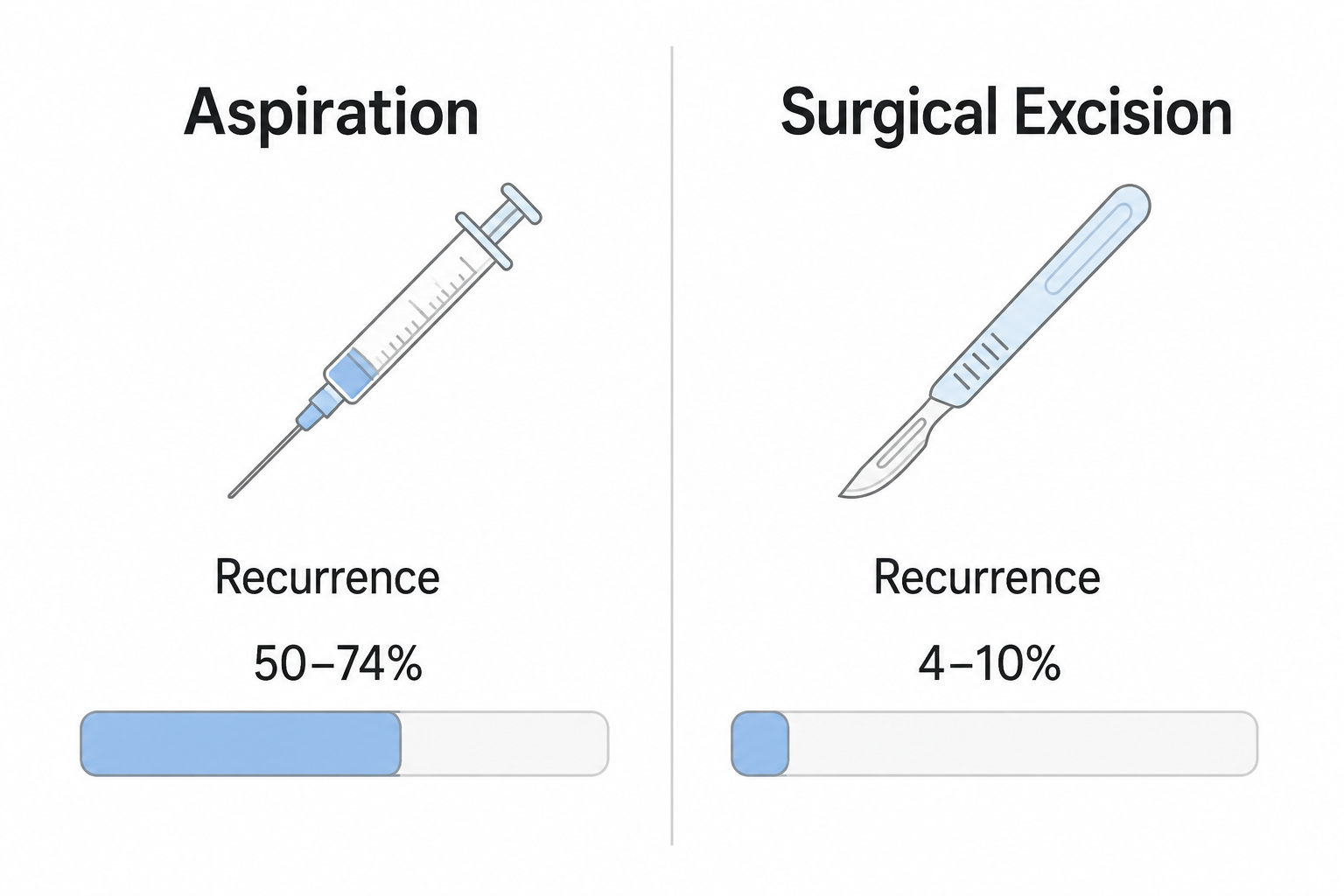
Aspiration involves passing a needle into the cyst and drawing the fluid out, sometimes with multiple small perforations of the sac to reduce how easily it refills. It is quick and low-risk, but recurrence is common — reported rates vary considerably across studies, broadly in the range of 50–74%, since the underlying sac and its connection to the joint are not removed, only emptied.4 Aspiration can be genuinely useful as a short-term measure — for example, ahead of a sporting event or an important occasion where a patient wants the lump reduced temporarily — but it should be understood as a temporary measure rather than a long-term solution.
Surgical excision removes the cyst along with its stalk back to the joint capsule, and carries a meaningfully lower recurrence rate, generally cited around 4–10%.5 It can be performed as an open procedure or arthroscopically (through several small incisions). Arthroscopic surgery was, for some years, seen as the more attractive cosmetic option, but two things have shifted opinion back toward open surgery for many surgeons: recurrence appears to run somewhat higher with the arthroscopic approach, and the cosmetic advantage is less clear-cut than it first appears, since an arthroscopic procedure typically requires three or four small incisions rather than the single, well-placed incision used in an open approach — which often heals at least as well.
A few patterns tend to point toward surgery rather than aspiration from the outset. Pearl ganglia, given their impact on grip, are generally less well suited to aspiration, and patients in this group more often prefer a definitive solution from the start. Surgery is also the more sensible route where a previous aspiration has already failed and symptoms have returned, or where the cyst is pressing on a nearby nerve and causing numbness or tingling rather than simply being a lump.
It is also worth noting that volar wrist ganglia specifically — as distinct from dorsal wrist ganglia — are generally regarded as more difficult to treat successfully. Because their origin is more variable and they sit closer to the radial artery and surrounding nerves, both aspiration and surgical excision carry meaningfully higher recurrence and complication rates for volar wrist ganglia than for dorsal ones, with some studies reporting recurrence after excision as high as 30–42% compared with the 4–10% typical of dorsal ganglia.10 This is a reasonable basis for a lower threshold toward surgical referral in this specific group, even though it reflects the difficulty of achieving a lasting result rather than any difference in how likely the cyst is to resolve on its own.
Some patients ask for a ganglion to be removed purely because they dislike how it looks. This is a reasonable request, but it is worth having a candid conversation first: a surgical scar can, in some cases, end up being more noticeable than the lump it replaced. This is a particularly important discussion for patients of African or Asian descent, whose skin carries a substantially higher risk of keloid scarring — raised, thickened scarring that can extend beyond the original incision — with some studies reporting keloid formation up to 15 times more likely than in lighter skin types.6 For patients in this group considering surgery for cosmetic reasons alone, that trade-off deserves to be discussed openly before proceeding.
"I should hit it with a heavy book (or a Bible) to make it go away." This is a genuinely old piece of folk medicine, and the history goes back further than the nickname itself. The word "ganglion" comes from the Greek for "knot," and was already being used to describe these lumps in medical writing as far back as Hippocrates, around 400 BC.7 The more recent nickname — "Bible bump," or its alternative name, "Gideon's disease" — refers specifically to the historical practice of rupturing the cyst with a heavy book: a Bible was typically the largest and most commonly available book in a household, hence both names describing the same practice. This practice has even been documented in the orthopaedic literature itself, in a case report of a patient whose ganglion resolved after an accidental knee injury, drawing a direct comparison to the folk remedy.8 Mechanically, the logic is sound: forcing the sac to rupture disperses the fluid, in much the same way aspiration does — it is simply a far less controlled way of achieving the same short-term effect. The risk is that an uncontrolled blow can also damage the tendons, nerves or blood vessels running close to the cyst, and on the palm side in particular, cause real injury to the surrounding structures. This is not a technique to attempt at home, however entertaining the folklore.
"This runs in my family, so it must be genetic." This is one of the most common things patients say, and it is understandable, given how often a ganglion does seem to appear in more than one family member. However, the cause of ganglion cysts remains genuinely unclear in the medical literature, and no confirmed genetic marker has been identified.1 A more likely explanation for the family clustering some patients notice is a shared connective tissue trait: a case-control study of 96 patients found generalised ligament hyperlaxity in 28% of patients with symptomatic dorsal wrist ganglions, compared with 13% of matched controls — suggesting that some families may simply share more flexible, stretch-prone connective tissue generally, rather than a specific inherited tendency to form ganglion cysts.9
A new lump on the hand or wrist is rarely an emergency, and for most patients, simple reassurance and monitoring is entirely appropriate. However, if the lump is causing persistent pain, growing quickly, affecting grip, or if there is any numbness or tingling alongside it, a specialist assessment is a reasonable next step. iiS Health offers on-site ultrasound assessment as standard, allowing a clear diagnosis — and, in most cases, genuine reassurance — in a single visit.





.png)