
Dupuytren's contracture causes one or more fingers — most often the ring and little fingers — to gradually curl into the palm and become impossible to straighten fully. Unlike trigger finger, where the finger catches on a narrowed tunnel but can still be straightened, a finger affected by Dupuytren's contracture cannot be passively pulled straight at all, because the problem is a genuine shortening of tissue rather than a mechanical obstruction.
For patients who do need treatment, there are three options in principle — needle fasciotomy, collagenase injection, and surgery — though as this article explains, one of those three is not currently available in the UK. This article sets out how each option actually works, and what determines which one suits a particular hand over another.

The body needs a way to keep skin anchored firmly to the muscles and bones underneath it, rather than sliding around loosely on top. This is done by a layer called fascia — in effect, a second, softer skeleton made of dense connective tissue that sits between skin and muscle throughout the body, gripping both together. In the palm of the hand and the sole of the foot, this layer of fascia is particularly thick and rigid, which is exactly why the skin there stays taut and does not shift the way skin does elsewhere on the body.
Dupuytren's contracture is a disease of this fascia specifically. It does not affect tendons — the tendons that bend the fingers sit in a separate, deeper layer and remain entirely normal, which is why a finger can still bend even as it becomes unable to straighten.
The disease process itself involves a build-up of type III collagen, the type normally associated with scar tissue, occurring alongside the type I collagen that makes up healthy fascia — an increased concentration of type III collagen within the tissue, rather than one replacing the other. Alongside this, specialised contractile cells called myofibroblasts proliferate within the tissue and actively pull, shortening it over time.1 This tends to progress through three recognised phases: an early proliferative phase, where nodules first appear in the palm; an involutional phase, where the tissue reorganises along the natural lines of tension in the hand and begins to form a tightening cord; and a residual phase, where the cellular activity settles but a dense, shortened cord remains, pulling the finger into a fixed, bent position.2
The typical patient is a man in his sixties of Northern European ancestry, often with a father or brother who has had the same condition, and who drinks somewhat more than average. Genetics play a substantial role: a large twin study found that around 80% of a person's overall risk of developing Dupuytren's contracture is attributable to genetic factors, and among people who do develop the condition, somewhere between 60% and 70% report a known family history.3
Historically, the condition's geographic pattern — common in Northern Europe, rare in people of primarily African or Asian descent — earned it the nickname "Viking disease." More recent genetic research has actually traced several of the key risk variants to a different, rather more surprising ancestral source: inherited DNA from Neanderthals.4 Real and fascinating science, whatever one makes of the ancestry involved.
Other recognised risk factors include diabetes, smoking, heavy alcohol use, liver disease, and certain medications used to treat epilepsy.5 Women do develop Dupuytren's contracture, though typically with a clearer family history than affected men.
A minority of patients — usually men under 50, with a strong family history — fall into a more aggressive category known as Dupuytren's diathesis. This group tends to develop the condition earlier, in both hands, more severely, and with a higher chance of recurrence after treatment. A useful clue to this category is the presence of the same disease process elsewhere in the body: as thickened pads on the back of the finger joints (Garrod's pads or knuckle pads), in the arch of the foot (Ledderhose disease), or, in men, affecting the penis (Peyronie's disease).6
Most patients notice firm lumps in the palm incidentally, often assuming they are calluses from manual work or weight training. It is usually only once a lump develops into a cord, and that cord begins pulling a finger out of a straight line, that patients seek medical attention.
Diagnosis relies on a detailed history — including asking specifically about lumps in the feet or any Peyronie's disease, given the diathesis link — combined with examination of the hand. Dupuytren's contracture is, in the great majority of cases, a clinical diagnosis made in the examination room. At iiS Health, ultrasound is used where there is any doubt about the diagnosis, since it can clarify exactly which tissue layer is affected and help distinguish Dupuytren's contracture from other causes of a palm lump, such as a ganglion cyst or a giant cell tumour of the tendon sheath.
Not necessarily. The majority of patients with early, uncomplicated Dupuytren's nodules in the palm never go on to develop a significant contracture, and the standard approach where there is no contracture yet is simply to monitor rather than intervene.7
One additional option exists for early-stage disease, before a contracture has developed: radiotherapy. Delivered in small, localised doses to the affected tissue, radiotherapy has been shown in long-term studies to slow or halt disease progression, with one audited series reporting progression stopped or improved in 91% of treated patients.8 There are downsides: it can affect how well skin heals if surgery is needed later, and while large long-term studies have not shown an increase in skin cancers, a small theoretical risk is generally acknowledged, given radiotherapy is a cancer treatment used at lower doses in this context. NICE has issued UK guidance on its use, and it is available on the NHS in a limited number of centres, more widely so privately. For this reason it tends to be reserved for patients with more aggressive, diathesis-type disease rather than offered routinely to every patient with early nodules.
Once a genuine contracture develops, the threshold generally used to decide when to intervene is 30 degrees of fixed bending, whether at the main knuckle (MCP joint) or the joint further along the finger (PIP joint) — some surgeons will accept slightly less at the PIP joint, perhaps down to around 25 degrees, but a contracture as small as 15 degrees is rarely enough to justify treatment, since the improvement gained would not be meaningful in practice. In practice, this threshold is usually also the point at which patients notice real day-to-day interference — catching the face while washing, being unable to shake hands properly, or struggling to get the hand flat into a pocket or a glove.
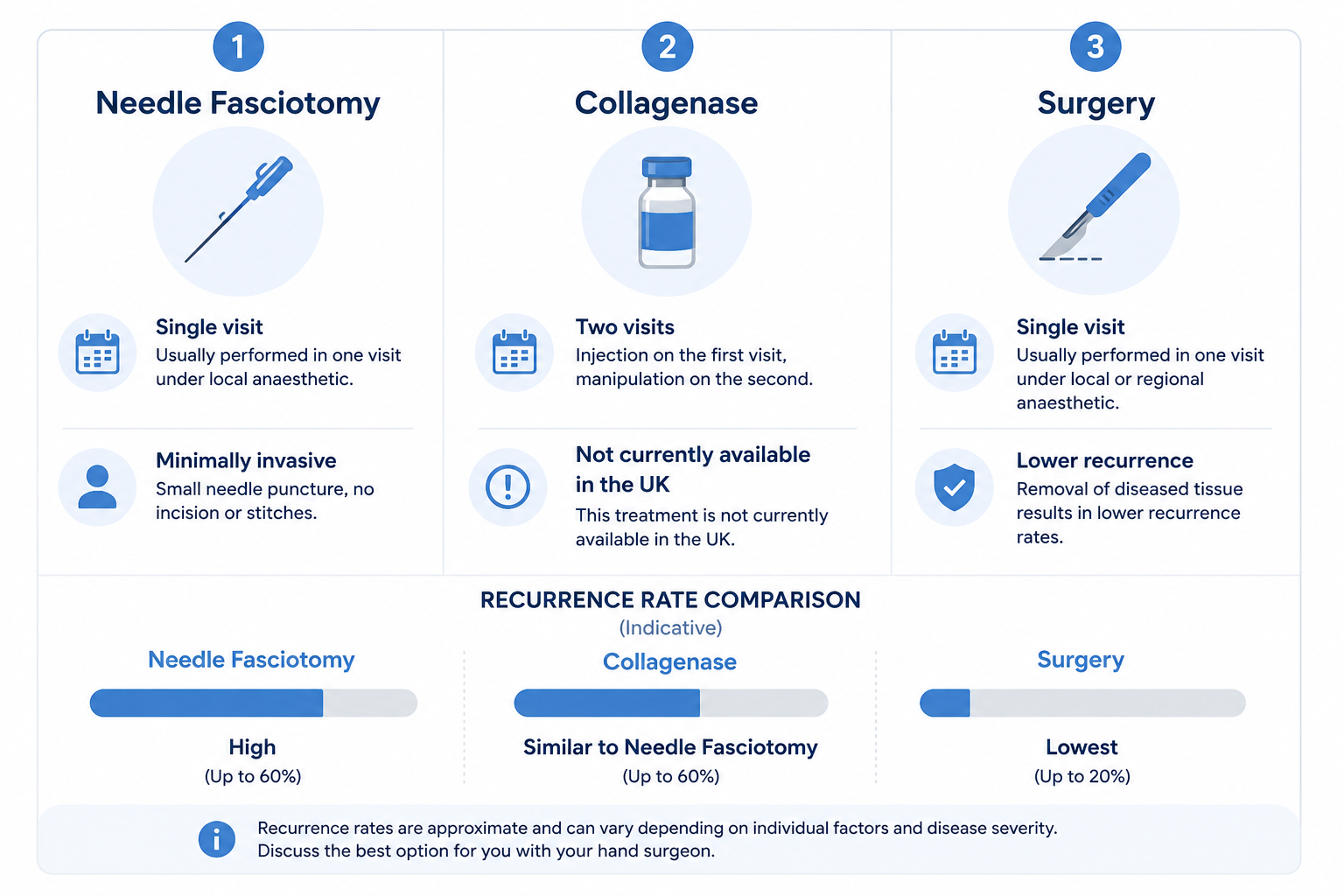
Needle fasciotomy involves passing a needle through the skin and using it to cut through the cord at several points along its length, weakening it enough that the finger can then be straightened. It is done in a single visit, can be performed under local anaesthetic, and offers a fast return to normal use. It is generally the preferred first option for an isolated contracture at the MCP joint. Where the contracture involves the PIP joint instead, needle fasciotomy becomes a less attractive option: the nerves and tendons in the finger sit much closer to the skin than they do in the palm, with far less separating them, and their exact position is also less predictable from patient to patient — both of which raise the risk of injury to these structures during a needle-based release.
Collagenase injection works by injecting an enzyme directly into the cord to break down its collagen, followed by a second appointment 48–72 hours later to manually manipulate and straighten the finger. Unlike needle fasciotomy, local anaesthetic cannot be used at the time of the initial injection, since it may interfere with the enzyme's action, which makes it a somewhat less comfortable procedure overall, spread across two visits rather than one. This option is not currently available in the UK: collagenase (marketed as Xiapex) was withdrawn from the UK and the rest of Europe from early 2020, a commercial decision by the manufacturer to focus on other markets, rather than any safety or efficacy concern.10
Surgery (fasciectomy) involves formally removing the diseased fascia through an open incision. It takes longer to recover from than either of the minimally invasive options, but achieves a more thorough removal of the diseased tissue, and is generally the better option once the PIP joint is significantly involved, since the surgeon can directly see and protect the surrounding nerves, arteries and tendons throughout the procedure.
This is where the real trade-offs lie, and the evidence is fairly consistent across studies:
For a younger patient — someone in their forties, for example — a needle fasciotomy's higher recurrence rate is not necessarily a poor outcome in itself. Even if the contracture returns within a few years, the procedure is quick, low-risk, and repeatable, and it defers a more invasive operation, potentially reducing the total number of procedures needed over that person's lifetime.
After needle fasciotomy: a bandage is worn for the first 24 hours, after which it and any small dressing can typically be removed by the patient. Driving is usually possible the next day or the day after, and the hand can generally get wet and be put to normal use straight away, unless there has been a small skin tear at the release site, in which case that area needs to heal first, in the same way as any other cut.
After surgery: a bandage is worn for 48–72 hours, followed by a wound check, with stitches typically removed at around ten days. The hand needs to stay dry and covered, and driving is not advised, until the wound has been reviewed and the stitches are out.
Regardless of which treatment is used, hand therapy and a night splint are generally arranged afterwards. The splint holds the finger in an extended position overnight. This is simply because the finger spends many hours in that position while healing, and keeping it straight during that time reduces the chance of it settling, or tightening back, into a bent position as the skin and tissue heal.
Because Dupuytren's contracture is a genetic, progressive condition rather than a one-off injury, the risk of it returning somewhere in the hand does not disappear after successful treatment. That risk continues to accumulate the longer a person lives, and is higher still in those with diathesis-type disease. Treatment resolves the current contracture, but for many patients, particularly those with a strong family history or diathesis features, it is unlikely to be the last treatment they ever need for the condition.
"Dupuytren's contracture is a thickening of the tendons." It is not. The tendons that bend the fingers sit in a completely separate, deeper layer and are entirely unaffected — which is exactly why an affected finger can still bend normally even as it becomes unable to straighten. The disease is confined to the fascia, the connective tissue layer that anchors skin to the structures beneath it.
"Everyone with Dupuytren's disease ends up with bent fingers." This is not the case. The majority of people who develop early nodules in the palm never progress to a significant contracture at all, and many go through life with the condition causing little more than a lump that is never treated.
A firm lump in the palm is not, by itself, a reason to rush into treatment — most never progress. However, if a finger has started to pull out of a straight line, or is beginning to interfere with everyday tasks like shaking hands or getting a hand flat into a pocket, a specialist assessment is a reasonable next step rather than waiting to see how far it goes. iiS Health offers on-site ultrasound assessment as standard, allowing a clear diagnosis and treatment plan in a single visit.







.png)