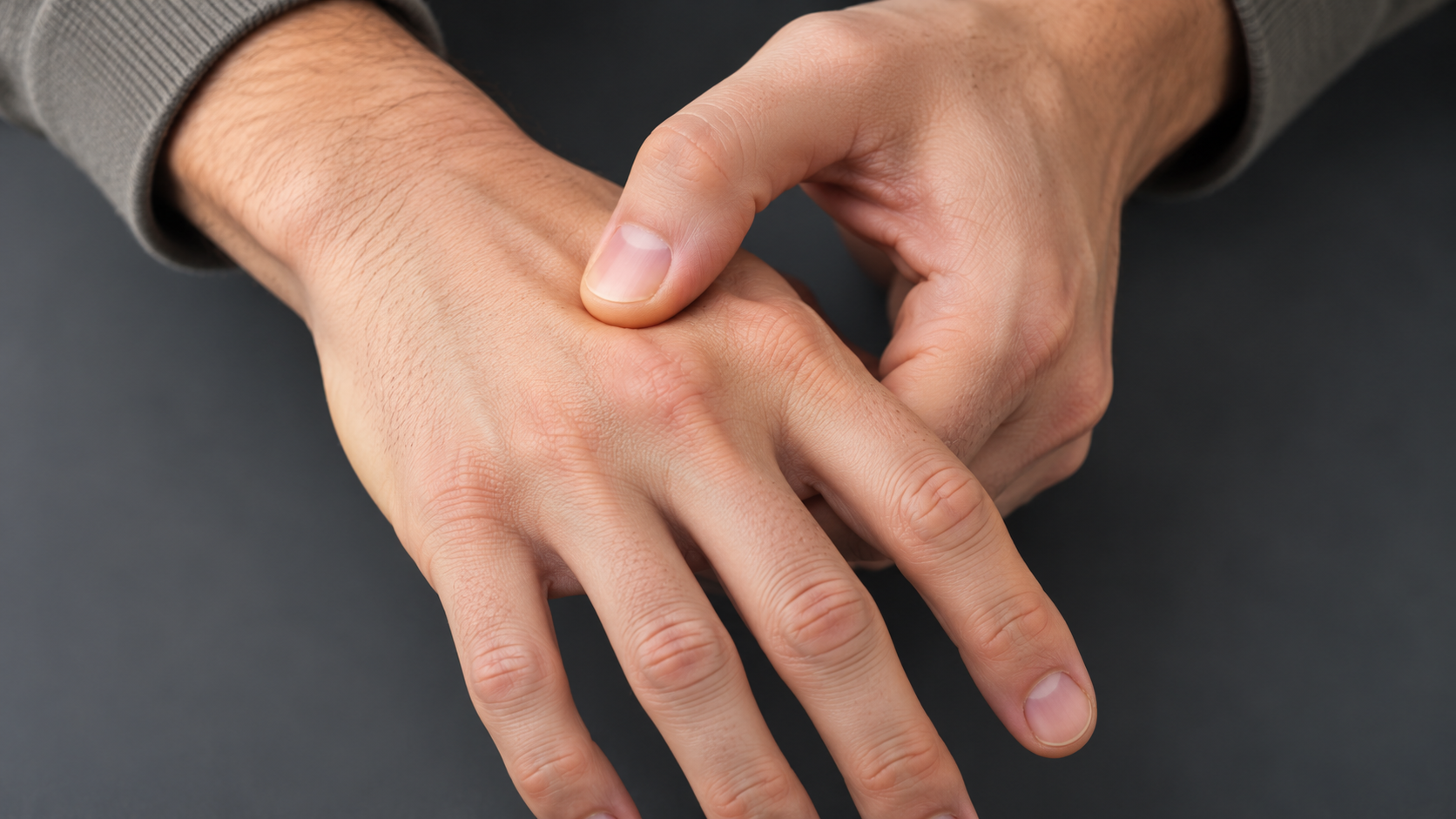
Where the thumb hurts, what started it and the person’s age usually point to the cause. A constant, deep ache at the base of the thumb that flares into sharper pain when pinching, turning keys or opening jars is most often thumb-base arthritis in someone over 50; in a teenager or young adult, arthritis is very unlikely. Sharp pain on the thumb side of the wrist when lifting suggests De Quervain’s tenosynovitis. A thumb that clicks or locks has trigger thumb. Pain and swelling at the thumb knuckle after the thumb was bent backwards or sideways, for example in a fall while skiing, suggests a torn ligament that needs prompt assessment. Pain near the wrist after a fall onto the hand needs checking for a scaphoid fracture.
Almost every grip and pinch the hand makes depends on the thumb. Its base joint moves in more directions than any other joint in the hand, which gives the thumb its reach but also concentrates a great deal of force through a small area. This guide explains the common causes of thumb pain, how to recognise each one, what helps, and which thumb injuries should not be left to settle on their own.
The thumb has three main joints. The carpometacarpal (CMC) joint sits at the base, deep in the fleshy part of the hand near the wrist. It is shaped like two saddles fitted together, which allows the thumb to swing across the palm, tilt and rotate. The metacarpophalangeal (MCP) joint is the thumb’s knuckle, in the middle of the thumb. The interphalangeal (IP) joint is the hinge nearest the tip.
The base joint’s freedom of movement comes at a cost. It is held together largely by ligaments rather than by the shape of the bones, and during a pinch it carries many times the force applied at the thumb tip.⁷ This is why it is one of the joints in the body most commonly affected by osteoarthritis. The knuckle joint has the opposite design. It moves mainly in one plane, like a hinge, and is held steady from side to side by two collateral ligaments. The ligament on the inner side, facing the index finger, is called the ulnar collateral ligament (UCL). It resists the thumb being pushed away from the hand, and every pinch depends on it. When it tears, pinch becomes weak and unstable. Around these joints run the tendons that move the thumb: two groups on the thumb side of the wrist (affected in De Quervain’s tenosynovitis), and one on the palm side that bends the thumb (affected in trigger thumb).
Thumb-base arthritis typically causes a constant, deep ache where the thumb meets the wrist. Pinching, gripping and twisting (turning keys, opening jars, writing, wringing out a cloth) do not create that ache, but make it flare into a sharper, more definite pain that can last for a while before settling back. It often starts after the age of 50 and is more common in women. Over time the joint can stiffen, pinch can weaken, and a bump may appear at the base of the thumb as the joint changes shape.¹ The most effective first treatments are a thumb-base splint, hand exercises tailored by a therapist, and practical aids that reduce pinching, together with anti-inflammatory gel for pain.¹ The clinic’s hand therapist makes custom thumb splints, and the clinic provides silver splints made by We Design Silversplints for people who need long-term support. A steroid injection into the joint can settle a painful flare. At iiS Health, these injections are given under ultrasound or X-ray guidance, so that the medicine reaches the joint accurately. Platelet-rich plasma (PRP) injections, made from a sample of the patient’s own blood, are also available, although the evidence for PRP in hand and wrist conditions is less well established than it is for arthritis of the knee. Surgery is reserved for people whose symptoms remain disabling despite these measures; the main options are removing the small wrist bone at the base of the thumb (trapeziectomy) or a thumb-base (CMC) joint replacement. More detail: Base Of Thumb Arthritis: Non-Surgical Options And When To See A Specialist.
Two groups of tendons that move the thumb run through a narrow tunnel over the bony bump on the thumb side of the wrist. In De Quervain’s tenosynovitis, the tunnel thickens and the tendons become painful as they move. The pain is sharp, sits slightly higher up than thumb-
base arthritis, and is brought on by lifting, gripping, and moving the thumb, particularly lifting with the thumbs spread. It is particularly common in mothers of newborn babies, and in people who have recently increased a repetitive task.³ A review of 30 randomised trials involving 1,663 people supported a steroid injection followed by three to four weeks in a thumb-and-wrist splint as a reasonable first treatment, although the extra benefit of the splint was small.² At iiS Health, every De Quervain’s injection is given under ultrasound guidance, so that it reaches the tunnel accurately. In the clinic’s experience, around seven in ten people settle after an injection. Most people therefore never need an operation. When the injection does not work, there is often an anatomical reason: the tunnel may be divided into two separate compartments, or there may be extra strands of tendon, sometimes as many as five, which the injection cannot reach as easily. In these cases, a small operation to open the tunnel is offered.
The tendon that bends the thumb tip passes under a band of tissue at the base of the thumb on the palm side, called the A1 pulley. If the tendon or pulley thickens, the tendon catches, causing a click, a painful catch, or a thumb that locks bent and has to be straightened with the other hand. There is often a tender lump at the base of the thumb in the palm, and the problem is usually worst in the morning.³ Research on samples of pulley tissue taken during surgery has shown changes in the pulley tissue that become more marked as symptoms become more severe, supporting the idea that this is a problem of the tendon’s tunnel rather than of the joint.⁸ Trigger thumb is a different problem from arthritis, even though both can cause pain on gripping. It responds to a splint, an injection, or release of the pulley.³ At iiS Health, the release can be carried out under ultrasound guidance, using a small instrument passed through an opening in the skin no larger than the one left by a drip (cannula). This avoids an open incision and allows a faster recovery. More detail: Trigger Finger Treatment Without Surgery.
A fall onto an outstretched hand while holding a ski pole, a ball striking the thumb, or the thumb catching on something as the hand moves can force the thumb away from the hand and tear the ulnar collateral ligament at the knuckle. This is often called skier’s thumb. It causes pain, swelling and bruising on the inner side of the thumb knuckle, and a pinch that feels weak or wobbly.⁴ The thumb can usually still bend and straighten, which leads many people to treat it as a simple sprain. The key question is whether the joint is stable. In some complete tears, the torn end of the ligament flips outwards and becomes trapped on the wrong side of a sheet of tissue from one of the thumb muscles, called the adductor aponeurosis, so that it cannot heal back to the bone. This is called a Stener lesion, and it is one of the main reasons that an unstable thumb ligament injury needs prompt assessment.⁴ ⁹
Sometimes the ligament pulls a small fragment of bone away with it. This matters, because testing the joint too forcefully can move the fragment out of place. The British Society for Surgery of the Hand (BSSH), the professional body that represents hand surgeons across the UK, recommends that acute injuries of this ligament are assessed with a history, examination and X-ray. Injuries without significant instability can be treated without surgery. Where the joint is significantly unstable, treatment may be either immobilisation or surgical repair, and the patient and clinician should reach a shared decision within two weeks of the person first seeking help.⁴ At iiS Health, an ultrasound scan in the consultation room shows whether the ligament is torn, whether it has become trapped, and often whether a fragment of bone has come away. If there is any doubt about a fragment, an X-ray is arranged. When the thumb can be treated without surgery, the clinic’s hand therapist makes a custom splint to protect the ligament while it heals. When the tear is unstable or the ligament is trapped, the repair is carried out at the clinic.
The scaphoid is a small wrist bone that sits just beyond the base of the thumb. It is the wrist bone most often broken in a fall onto an outstretched hand, and a fracture can cause surprisingly little swelling. Tenderness in the hollow that appears at the base of the thumb when the thumb is stretched outwards (the anatomical snuffbox) is a key warning sign. Some scaphoid fractures do not show on the first X-ray, so persistent tenderness after a fall should be reassessed rather than dismissed.⁵ A standard wrist X-ray can miss a scaphoid fracture. At iiS Health, a suspected scaphoid fracture is X-rayed with scaphoid views, which show the bone from four different angles to give the best chance of finding a break. If there is still any doubt, an MRI scan is arranged, usually within a week. More detail: Why Scaphoid Fractures Are Missed.
Tingling or numbness affecting the thumb together with the index and middle fingers, often waking a person at night and relieved by shaking the hand, is typical of carpal tunnel syndrome, where the median nerve is squeezed at the wrist. In more advanced cases, the muscle at the base of the thumb can waste and the thumb becomes weak when pressed against the fingers.⁶ More detail: Carpal Tunnel Syndrome: Causes, Diagnosis And Treatment.
Treatment of thumb ligament injuries. The BSSH guideline was developed with patients, hand surgeons, therapists and emergency doctors. It recommends non-surgical treatment for injuries without significant instability, and a shared decision on immobilisation or surgical repair, within two weeks, for injuries with significant instability.⁴
Scans for a trapped ligament. A review of studies on Stener lesions found that ultrasound correctly identified 95% of them and MRI 93%, with both rarely giving false alarms. The authors noted that the underlying studies had a high risk of bias, so these figures are best treated as encouraging rather than definitive.⁹ Normal X-rays do not rule out a scaphoid fracture. A 2023 review in the Emergency Medicine Journal found that around 9% of people with a suspected scaphoid fracture and normal first X-rays did have a fracture, and that no single examination finding could reliably rule one out. The absence of snuffbox tenderness made a fracture considerably less likely.⁵
For gradual thumb pain without injury:
After an injury:
Book a routine appointment with a hand specialist for gradual thumb pain that is affecting daily tasks, a thumb that clicks or locks, or pain that has not improved after a few weeks of changes. Seek assessment within a few days after a thumb has been forced backwards or sideways and the knuckle is swollen, bruised or unstable, and after a fall onto the hand with tenderness at the base of the thumb, even if an X-ray was normal.⁴ ⁵ Seek same-day medical help for obvious deformity, a deep wound, numbness after an injury, a thumb that becomes pale, cold or blue, or a hot, swollen, very painful thumb, particularly with a fever. NHS 111 can direct urgent care when the right service is unclear, and 999 should be called in an emergency.
The assessment begins with exactly where the pain is and how it started. The examination then tests each structure directly:
X-rays show arthritis and fractures, including small fragments of bone pulled off by a torn ligament, and are recommended for every acute thumb ligament injury.⁴ Ultrasound or MRI can show whether a torn ligament has become trapped.⁹ At iiS Health, the ultrasound machine is in the consultation room, so a scan can usually be carried out there and then, as part of the appointment and at no extra cost. MRI is the usual next step when a scaphoid fracture is suspected despite normal X-rays.
“It is arthritis, so nothing can be done.”
This is the belief the clinic hears most often from people with thumb-base arthritis, and it is wrong. Splints, exercises, practical aids, anti-inflammatory gel and injections help most people, and for those who still struggle, surgery reliably relieves pain.¹
“Pain at the base of the thumb is always arthritis.”
Thumb-base arthritis is common, but De Quervain’s tenosynovitis, a scaphoid fracture and trigger thumb all cause pain in nearby areas. The exact spot and what triggers it distinguish them.³
“If the thumb still moves, the ligament cannot be badly torn.”
A completely torn thumb ligament usually still allows the thumb to bend and straighten. What is lost is side-to-side stability, which only a careful examination reveals.⁴
“Every complete thumb ligament tear needs an operation.”
Significantly unstable injuries may be treated either with immobilisation or with surgical repair, through a shared decision between patient and clinician within two weeks.⁴
“A clicking thumb means the joint is worn out.”
Clicking and locking usually come from the tendon catching under its pulley, which is trigger thumb, not from the joint.³ ⁸
“A normal X-ray after a fall means nothing is broken.”
Around 9% of people with a suspected scaphoid fracture and normal first X-rays do have a fracture.⁵ Persistent tenderness at the base of the thumb should be reassessed.
Why does the base of my thumb hurt when I open a jar?
Opening a jar combines a strong pinch with a twist, which places a large load on the joint at the base of the thumb. In thumb-base arthritis there is usually a constant background ache, and this kind of task makes it flare into a sharper pain.¹ ⁷
What is skier’s thumb?
It is a tear of the ulnar collateral ligament at the thumb knuckle, usually caused by the thumb being forced away from the hand, for example in a fall while holding a ski pole. It needs assessment within days, because some tears cannot heal properly without treatment.⁴
Do I need surgery for a torn thumb ligament?
Not necessarily. Injuries without significant instability are treated without surgery. For unstable injuries, the choice between immobilisation and surgical repair is a shared decision, made within two weeks.⁴
Will a thumb splint help?
It depends on the cause. A thumb-base splint helps arthritis at the base of the thumb,¹ a thumb-and-wrist splint is used after an injection for De Quervain’s,² and a custom splint protects an injured ligament. A general support may not help any of these.
Will I need an operation for De Quervain’s?
Usually not. In the clinic’s experience, around seven in ten people settle after an ultrasound-guided injection. An operation is offered when the injection does not work, which often reflects an anatomical variation in the tunnel.
Why does my thumb lock?
Locking usually means the tendon that bends the thumb is catching under its pulley at the base of the thumb, which is trigger thumb. It is treated with a splint, an injection, or release of the pulley, which can be done under ultrasound guidance through an opening in the skin no larger than a drip site.³
Can thumb numbness come from carpal tunnel syndrome?
Yes. Numbness or tingling in the thumb together with the index and middle fingers, especially at night, is typical of carpal tunnel syndrome.⁶
iiS Health, based at The Cheshire Hand Clinic in Warrington, provides specialist assessment and both surgical and non-surgical treatment for thumb, hand and wrist conditions, including thumb-base arthritis and thumb ligament injuries.
Mr Fizan Younis is a Consultant Orthopaedic Hand and Wrist Surgeon and the founder and Medical Director of iiS Health. His procedural interests include wrist arthroscopy, endoscopic surgery and ultrasound-guided treatment.