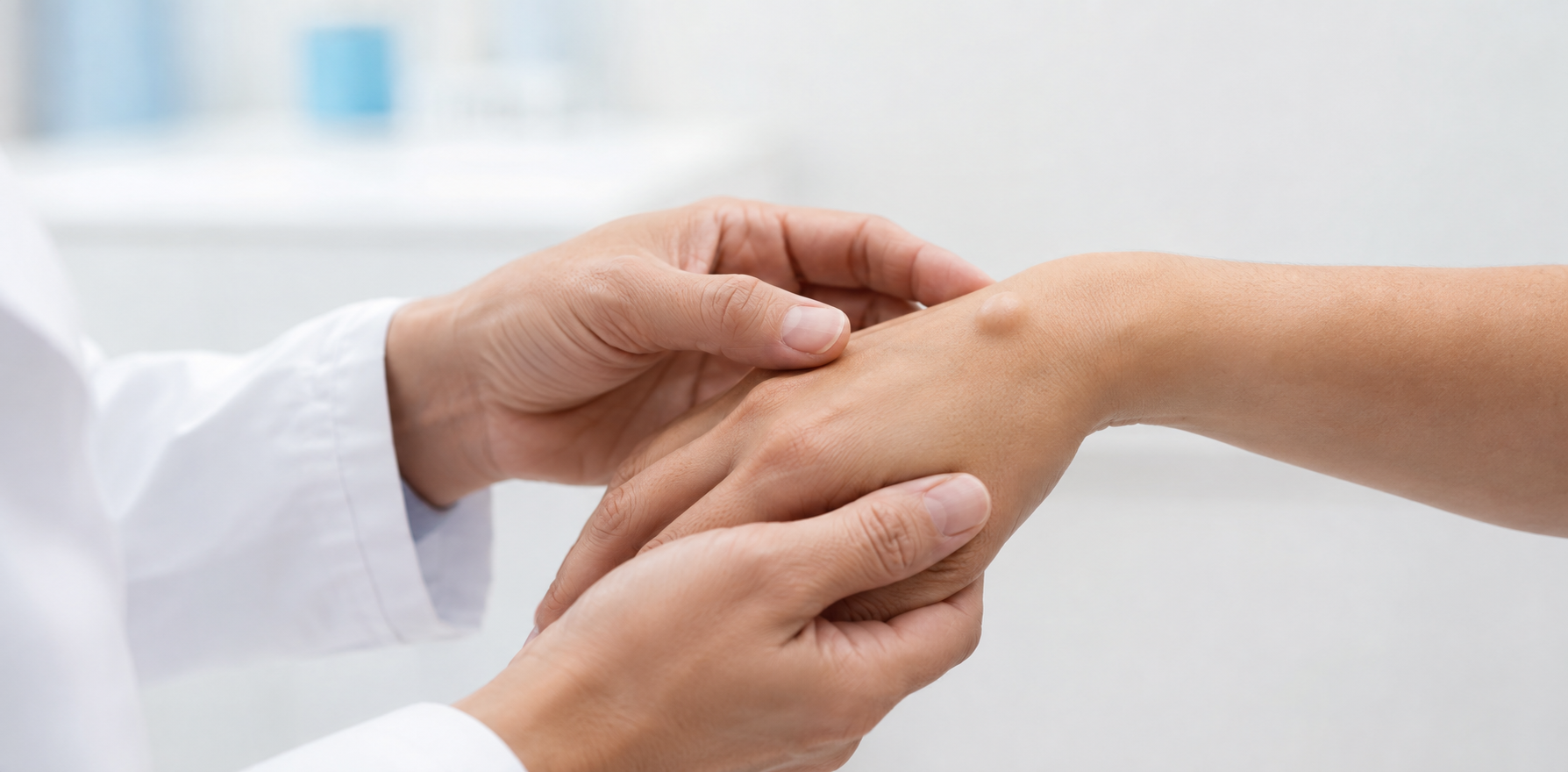
Pain on the back of the hand is best understood by how it started. Pain that began with a fall, a blow or a punch is most often a broken hand bone (a metacarpal fracture) and needs an X-ray. Pain after a cut, especially if a finger now droops or will not straighten fully, suggests a damaged tendon and needs assessment the same day. Pain that has built up gradually around a lump near the wrist is most often a ganglion cyst, or less commonly a bony bump called a carpal boss. Pain at the back of the wrist only when leaning on the hand has its own set of causes. The back of the hand has very little padding. The five long hand bones and the tendons that straighten the fingers lie just under the skin, which is why this part of the hand is so easily injured and why even small cuts here can reach important structures. This guide explains how to recognise each of the common causes, what can be done at home, and which situations should not wait.
Five long bones called metacarpals run from the wrist to the knuckles, one for each finger and the thumb. Lying over them, just beneath the skin, are the extensor tendons, which straighten the fingers and thumb. These tendons are joined to each other near the knuckles by small bands of tissue, which help the fingers move together.² Closer to the wrist, the back of the hand meets the small carpal bones of the wrist, held together by ligaments and enclosed in a joint capsule. This is where ganglion cysts most commonly form.³ Two features of this anatomy matter for patients. First, there is very little between the skin and the tendons, so a cut that looks minor can still damage a tendon. Second, the connections between neighbouring tendons can allow a finger to straighten partly even when its own tendon has been cut, which can make a serious injury look reassuringly mild.²
A metacarpal fracture typically causes swelling across the back of the hand, tenderness over one bone, bruising, and pain on gripping. The fracture at the neck of the little finger metacarpal, just behind the knuckle, is so commonly caused by punching a hard object that it is often called a boxer’s fracture. The knuckle may look flattened or sunken.¹ Many metacarpal fractures heal well with a short period of support followed by early movement. The features that change the plan are rotation, significant shortening or angulation, fractures that enter a joint, and multiple fractures.¹ Rotation is the most important for patients to know about, because a small twist at the fracture can make a finger overlap its neighbour every time the hand closes, which interferes with grip for life if it is not corrected. Gently curling the fingers into a loose fist and checking whether they all point towards the same spot is a simple way to spot it.
A small cut over a knuckle caused by a fist striking someone’s teeth is easy to dismiss, but it is one of the most important injuries on the back of the hand. Teeth carry large numbers of bacteria, and when the fist is clenched, the tooth can pass through the skin into the tendon or the knuckle joint itself. When the hand is then opened, the wound slides away from the deeper damage and seals the bacteria in. These injuries need same-day assessment at A&E, because the bacteria in a human mouth can cause a severe infection that damages the joint if it is not treated promptly. Treatment usually involves antibiotics and often a wound wash-out, even when the cut looks tiny.
If a finger droops at the knuckle or the middle joint after a cut on the back of the hand, or cannot be straightened as fully or as strongly as the others, an extensor tendon may be damaged. Because neighbouring tendons are linked, a partly cut tendon, or even a fully cut one, may still allow some movement, so the size of the cut and the ability to wiggle the finger are both poor guides.² Any cut over the back of the hand with a change in finger movement, numbness, or a deep wound should be assessed the same day.
A ganglion is a fluid-filled swelling that grows out of a joint or tendon sheath, most often from the back of the wrist. It feels smooth and rubbery, may change size from week to week, and is frequently painless, although it can ache when the wrist bends backwards or when something presses on it.³ Ganglia are benign, and the first step is usually reassurance. Any lump can raise fears of something serious, so confirming the diagnosis matters. A ganglion can usually be recognised by examination, and at iiS Health an ultrasound scan in the consultation room confirms it there and then, so patients can be certain it is a harmless cyst. Around six in ten wrist ganglia go away on their own without treatment, although this can take several years.⁶ Leaving one alone is therefore a reasonable choice when it is not causing problems. Draining the fluid with a needle (aspiration) is quick, but the cyst comes back in about half of cases.⁶ Surgical removal (excision) gives the best chance of the cyst not returning, although it can still recur.⁶ ⁷ Excision can be done through a small open incision or by keyhole (arthroscopic) surgery, and the evidence has not shown a clear advantage for either.⁷ At iiS Health, excision is performed through a single small open incision. Hitting a ganglion with a heavy book, a traditional home remedy, should not be attempted: it can injure the hand and does not reliably remove the cyst. More detail: Ganglion Cyst: Will It Go Away On Its Own, And Do I Need Surgery?
A carpal boss is a bony prominence on the back of the hand where the base of the index or middle finger bone meets the wrist. Unlike a ganglion, it is hard, does not move, and does not change size. It is often painless, but can become sore with pressure, repeated wrist movement, or if a tendon catches over it.³ ⁴ Because a ganglion sometimes forms on top of a carpal boss, the two can be confused, and an X-ray taken at a particular angle helps tell them apart.⁴
Pain that appears only when weight goes through a bent-back wrist, as in a press-up, a plank, or pushing up from a chair, comes from a different set of structures. In a study of patients with exactly this pattern, MRI scans found a problem at the back of the wrist in 84%, most commonly a small ganglion too deep to see or feel.⁵ This is covered in detail in Why Do My Wrists Hurt When I Do Push-Ups?
Pain centred on the knuckle joints themselves, with stiffness and swelling, is more likely to come from a joint problem such as arthritis than from the back of the hand. Soft swelling of several knuckles with long morning stiffness needs prompt assessment for inflammatory arthritis. This is covered in What Is The Difference Between Inflammatory Arthritis And Osteoarthritis In The Hands?
Most hand bone fractures do not need an operation. A 2023 review of closed finger and metacarpal fractures found that many can be treated without surgery, and that the decision depends mainly on rotation, displacement, joint involvement and stability, with the aim of preserving finger movement and grip.¹ Ganglia often settle without treatment. A UK study that followed people with dorsal wrist ganglia for an average of nearly six years found that 58% of untreated ganglia resolved on their own. Ganglia recurred in 58% of people after aspiration and 39% after surgical excision.⁶ Hidden ganglia are a common cause of weight-bearing wrist pain. In a study of 25 patients with pain at the back of the wrist when leaning on the hand, 84% had a problem at the back of the wrist on MRI, compared with 12% of a comparison group, and three quarters of those problems were hidden ganglia.⁵
For a minor knock with no deformity, no open wound and normal finger movement:
For a ganglion that is not causing problems, no treatment is needed. If it aches, reducing the activity that aggravates it, such as prolonged weight-bearing through the wrist, often helps. Persistent pain after a fall or blow, any obvious deformity, or any doubt about the fingers’ alignment needs an early X-ray and assessment rather than further home care.
Book a routine appointment with a hand specialist for a lump that is growing, painful or affecting movement, for a hard bump that is sore with use, or for pain that keeps returning. Seek assessment within a day or two for pain, swelling and tenderness over a hand bone after a fall, punch or blow, even if the fingers still move. Seek same-day medical help for a cut from a punch that struck teeth, a cut with a drooping finger or reduced finger movement, any deep cut, numbness after an injury, a finger that crosses over its neighbour when the hand is closed, obvious deformity, a hand that becomes pale, cold or blue, or a hot, swollen, spreading redness on the back of the hand. NHS 111 can direct urgent care when the right service is unclear, and 999 should be called in an emergency.
The assessment starts with exactly how the pain began. After an injury, the specialist checks the alignment and rotation of each finger as the hand closes, feels each bone for tenderness, and tests the straightening of each finger individually against gentle resistance, because a partly damaged tendon is often weak rather than completely non-functioning.² Sensation and circulation are checked in every injured hand. X-rays are the first test for a suspected fracture and help distinguish a carpal boss from a ganglion.¹ ⁴ Ultrasound can confirm a ganglion, show which joint or tendon it arises from, and assess a tendon injury. At iiS Health, the ultrasound machine is in the consultation room, so a scan can usually be carried out there and then, as part of the appointment and at no extra cost. MRI is reserved for questions that ultrasound and X-rays cannot answer, such as a suspected hidden ganglion or ligament injury at the back of the wrist.⁵ Treatment then follows the diagnosis: support and early movement for most fractures, with surgery for those that are rotated, unstable or involve a joint; repair or a specialised splint for tendon injuries depending on where and how badly the tendon is damaged; and observation, aspiration or surgery for ganglia depending on symptoms.¹ ² ³
“If I can move my fingers, the hand is not broken.”
Fingers can often move despite a metacarpal fracture. Persistent swelling and tenderness over a bone after a fall or blow needs an X-ray, and a finger that overlaps its neighbour when the hand closes suggests a rotated fracture.¹
“A finger that still straightens cannot have a cut tendon.”
Connections between neighbouring extensor tendons can allow partial straightening even when a tendon is cut. Weakness when straightening the finger against gentle resistance is often the only sign.²
“A small cut on the knuckle from a fight is nothing to worry about.”
A cut caused by teeth can carry bacteria deep into the tendon or joint and needs same-day assessment at A&E, however small it looks.
“A lump on the back of the wrist always needs removing.”
Around six in ten wrist ganglia go away without treatment, and surgery is generally reserved for ganglia that are painful, limiting, or causing concern.⁶
“Every hard lump on the back of the hand is a ganglion.”
A carpal boss is a bony bump, not a cyst, and needs a different approach. An examination and sometimes an X-ray tell them apart.⁴
How do I know if I have broken a bone in my hand?
Swelling, bruising and pinpoint tenderness over one bone after a fall, blow or punch are the main signs, often with pain on gripping. A finger that crosses over its neighbour when the hand is closed, or a knuckle that looks flattened, makes a fracture more likely. Only an X-ray can confirm it.¹
What is a boxer’s fracture?
It is a break at the neck of the little finger metacarpal, just behind the knuckle, usually caused by punching a hard surface. Many heal well without surgery, provided the finger has not rotated.¹
Will my ganglion go away on its own?
It may. Around six in ten wrist ganglia resolve without treatment, although it can take several years.⁶ One that is painful, growing or limiting movement is worth assessing.
What is the difference between a ganglion and a carpal boss?
A ganglion is a soft or rubbery fluid-filled cyst that can change size. A carpal boss is a hard, fixed bony bump at the base of the index or middle finger bone. Examination and an X-ray distinguish them.³ ⁴
Why does the back of my wrist hurt when I do press-ups?
Leaning on a bent-back wrist loads the structures at the back of the wrist. A study of patients with this exact pattern most commonly found a small hidden ganglion on MRI.⁵
Should I take my rings off after hurting my hand?
Yes, straight away. Swelling can make rings impossible to remove later and can restrict the blood supply to the finger.
iiS Health, based at The Cheshire Hand Clinic in Warrington, provides specialist assessment and both surgical and non-surgical treatment for hand and wrist conditions, including hand fractures, tendon injuries and ganglion cysts.
Mr Fizan Younis is a Consultant Orthopaedic Hand and Wrist Surgeon and the founder and Medical Director of iiS Health. His procedural interests include wrist arthroscopy, endoscopic surgery and ultrasound-guided treatment.