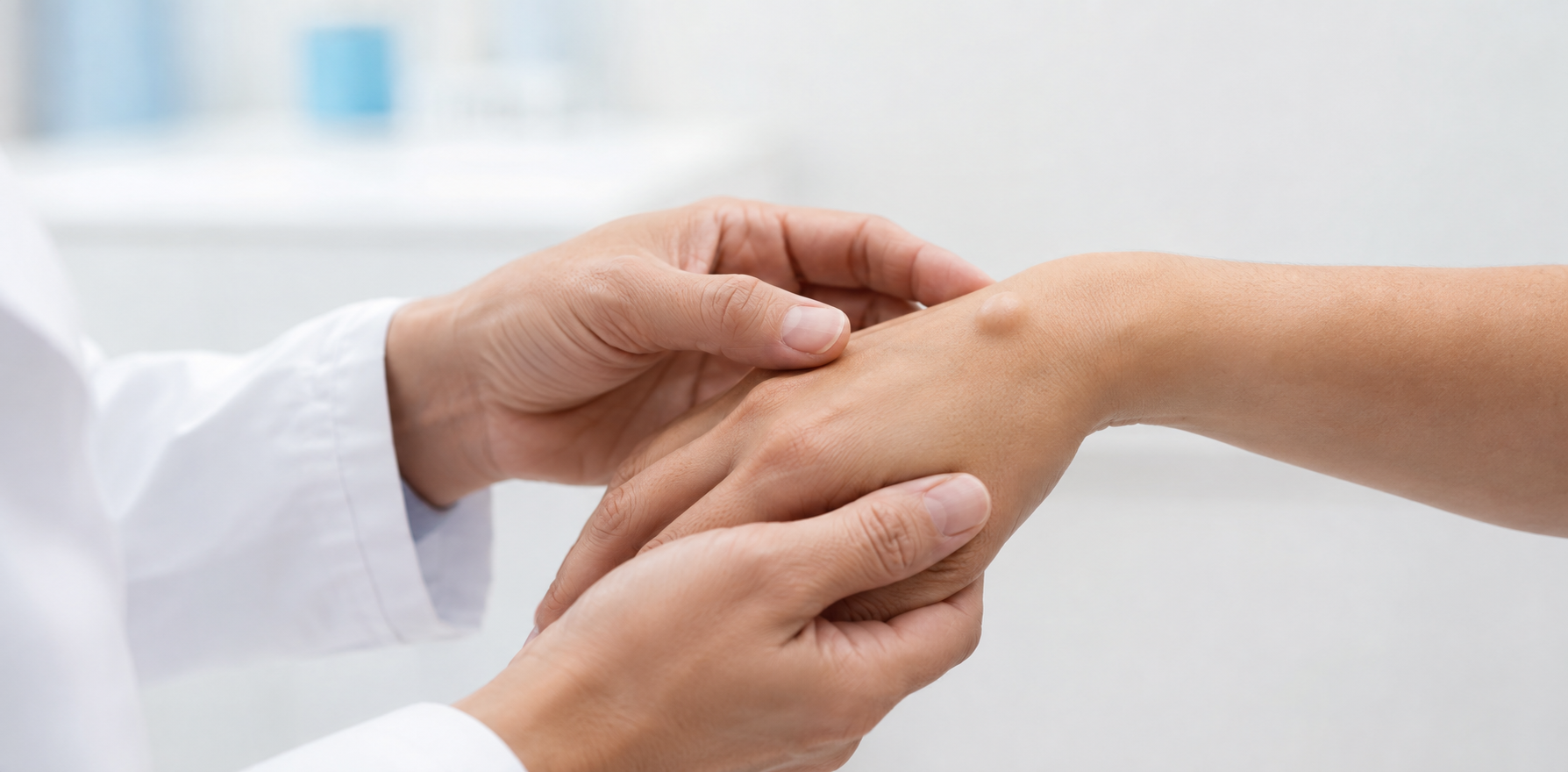
A small, tender lump at the base of a finger that hurts when a handle presses on it is usually one of three things, and the exact position of the lump and what the finger does are the best clues. A firm, pea-sized lump at the crease where the finger meets the palm, with a finger that moves normally, is most often a pearl ganglion, a tiny fluid-filled cyst. A tender spot a little lower, over the knuckle in the palm, with a finger that clicks or locks, is usually trigger finger. A firm nodule in the skin of the palm, sometimes with a cord running towards a finger, suggests Dupuytren’s disease. All three are benign, but they are treated differently. The base of the fingers is exactly where a bag handle, a steering wheel, a gym bar or a walking stick presses hardest, so even a very small lump in this area can make everyday gripping miserable. This guide explains how to tell the common causes apart, what each one means, what can be done, and when a palm lump should be examined.
The tendons that bend the fingers run along the palm inside a protective sheath. Over the knuckle on the palm side, each tendon passes under a band of tissue called the A1 pulley, which holds it close to the bone so the finger can bend efficiently. Just under the palm skin lies a tough layer called the palmar fascia. It works like the underlay beneath a carpet: it grips the skin from below, and is itself anchored to the bones and muscles, so the skin of the palm stays still and keeps its shape instead of sliding around when something is gripped. The nerves and arteries that supply each finger run alongside the tendons, very close to the surface. Each of the common palm lumps comes from a different one of these layers:
Because most lumps in this area are attached to structures that do not move, whether a lump moves when the finger bends is not a reliable guide. The useful clues are where exactly the lump sits, what it feels like, and what the finger does.
Dupuytren’s disease begins with firm nodules in the palm, most often in line with the ring or little finger. Over months to years, some nodules develop into cords that run towards the finger and gradually pull it into a bent position. Early nodules can be tender, particularly under pressure, but the condition is usually painless once established.³ It is more common in men, in people of northern European ancestry, and in people with a family history of it.³ Long-term follow-up has shown that the condition can progress, but many people with nodules never develop a significantly bent finger.⁴ A simple self-check is to place the hand palm down on a table. If the palm and fingers can no longer lie flat, the finger is usually bent by about 30 degrees, and there is a good chance it will continue to bend. That is the usual point at which treatment is discussed with a hand specialist.
A pearl ganglion is typically a few millimetres across, firm or even hard, and sits on the palm side of the finger at, or just beyond, the crease where the finger meets the palm. It is usually painless at rest and painful when something presses directly on it, such as a bag handle, a steering wheel, a gym bar or a racket grip. The finger moves normally, without clicking.¹ ² The tendon sheath is a tunnel filled with a lubricating fluid that lets the tendon glide. A pearl ganglion is a small pouch of the sheath, filled with a thicker, jelly-like version of that fluid.²
In trigger finger, the tender spot sits a little lower, over the knuckle on the palm side, where the A1 pulley lies. The main problem is mechanical: the finger clicks as it straightens, may lock in a bent position and need to be straightened with the other hand, and is usually worst first thing in the morning. Trigger finger is more common in people with diabetes, and the ring finger and thumb are most often affected.³ More detail: Trigger Finger Treatment Without Surgery.
Other lumps can occur in this area. A giant cell tumour of the tendon sheath is a benign, slow-growing lump that sits on the tendon sheath and, like a pearl ganglion, usually does not move; it feels firmer and more rubbery than a fluid-filled cyst. An epidermal inclusion cyst can form after a penetrating injury such as a splinter, thorn or cut: the top layer of the skin is pushed deeper, and a lump forms in reaction to it being in an unusual place. These are uncommon, but they are one reason why a lump that is growing, unusual or not behaving like the patterns above should be examined rather than assumed to be harmless.
Surgical removal of a painful pearl ganglion is usually successful. A series of 24 patients with 25 painful ganglia of the finger tendon sheath treated by surgical removal found no recurrence during an average follow-up of 18.5 months, and two minor complications both settled.² These were patients selected for surgery, so the results describe what happens when an operation is needed, not the natural course of every pearl ganglion. Dupuytren’s disease does not always progress. An 18-year follow-up study from Iceland found that the condition can progress over time, but not every nodule goes on to cause a bent finger.⁴ This is why most early nodules are simply monitored.
Many pearl ganglia settle on their own, so if one is not troublesome it can simply be watched. Draining the fluid with a needle is quick, but the cyst often comes back.¹ Because of where they sit, pearl ganglia catch on almost everything that is gripped, such as a steering wheel or a shopping bag, and they are the ganglia that people most often choose to have removed. Surgical removal is a small procedure and, in published results, usually successful.²
Trigger finger is treated with a splint, a steroid injection, or a small operation to release the pulley if symptoms persist. iiS Health also offers ultrasound-guided trigger finger release, in which the pulley is released through a needle under ultrasound guidance rather than through an open incision, allowing a faster recovery. These options are covered in Trigger Finger Treatment Without Surgery.
While the hand can still lie flat, most nodules are simply monitored, because many never progress and treatment carries its own risks.⁴ For people with particularly aggressive disease, often those who develop it young or have a strong family history, radiotherapy to early disease can be considered: although radiotherapy is better known as a cancer treatment, there is some evidence that it slows Dupuytren’s disease. The evidence is still limited, so it is only offered in specialist settings.⁵ iiS Health does not provide radiotherapy, but can advise on referral where appropriate. Once a finger has started to bend, iiS Health offers:
Collagenase injections, which contain an enzyme that dissolves the collagen in the cord, were previously used in the UK but are no longer available. Needle fasciotomy has largely taken their place. It straightens the finger in a single visit, and local anaesthetic can be used beforehand, whereas the first collagenase injection was normally given without local anaesthetic, to avoid interfering with the enzyme.
For a painful lump without any warning signs:
Padding helps symptoms but does not make a pearl ganglion or Dupuytren’s nodule go away.
Book a routine appointment with a hand specialist for a lump that is painful enough to affect gripping, for a finger that clicks or locks, or if the hand can no longer be laid flat on a table. Seek an appointment promptly for a lump that is growing quickly, feels hard and fixed, has an unusual colour, or comes with numbness or tingling in the finger. Seek same-day medical help if a finger becomes red, hot, swollen and very painful, particularly after a cut or splinter, or if a finger locks and cannot be straightened at all.⁶ NHS 111 can direct urgent care when the right service is unclear, and 999 should be called in an emergency.
The specialist notes exactly where the lump sits, feels its consistency, and watches the finger bend and straighten for clicking or locking. Whether the lump is at the finger crease or over the knuckle, whether it feels fluid-filled, rubbery or part of the skin, and whether the finger catches are usually enough to tell the common causes apart. The finger is also checked for full straightening, sensation and circulation. Ultrasound can confirm a fluid-filled cyst, show where it arises, and distinguish a ganglion from a solid lump such as a giant cell tumour. At iiS Health, the ultrasound machine is in the consultation room, so a scan can usually be carried out there and then, as part of the appointment and at no extra cost. Ultrasound is not usually needed for a typical trigger finger or Dupuytren’s nodule, which are diagnosed by examination.³
“Every lump in the palm is a ganglion.”
Pearl ganglia are common, but trigger finger nodules, Dupuytren’s nodules and less common lumps such as giant cell tumours occur in the same area and need different treatment. The position of the lump, its feel and whether the finger clicks are the key differences.² ³
“If the lump does not move, it must be something serious.”
Most lumps at the base of the finger, including pearl ganglia and trigger finger nodules, do not move, because they are attached to the tendon sheath or the pulley. A fixed lump in this area is usually benign, although one that is growing or unusual should be examined.
“A Dupuytren’s lump will always end up bending the finger.”
Long-term follow-up shows that the condition progresses in some people but not in others.⁴ Many nodules are simply monitored until, or unless, the finger starts to bend.
“Bursting the lump at home will fix it.”
Squeezing or piercing a palm lump risks injuring the nerves and arteries to the finger and introducing infection, and does not reliably remove the cyst.
Is a lump in my palm cancer?
The great majority of palm lumps are benign: pearl ganglia, trigger finger nodules and Dupuytren’s nodules account for most of them. A lump that is growing quickly, is hard and fixed, or does not fit these patterns should be examined, and an in-clinic ultrasound scan can give a good indication of what it is likely to be.
Why does the lump only hurt when I carry bags or drive?
A pearl ganglion sits exactly where a bag handle or steering wheel presses at the base of the finger. It is usually painless until something squeezes it against the bone beneath.²
Will a pearl ganglion go away by itself?
Many do. If it is not causing problems, it can be left alone. If it keeps catching on things when gripping, removal is a small procedure and is usually successful.² ¹
How can I tell trigger finger from a pearl ganglion?
Trigger finger causes clicking, catching or locking, with tenderness over the knuckle on the palm side. A pearl ganglion sits slightly further up, at the finger crease, hurts under pressure, and the finger moves smoothly.² ³
When should Dupuytren’s disease be treated?
Treatment is usually discussed when the condition begins to bend the finger, typically when the palm and fingers can no longer be laid flat on a table.
Is needle treatment for Dupuytren’s disease painful?
The local anaesthetic injection is a little uncomfortable: the needle can be felt going in, and it stings for a few seconds as the anaesthetic goes in. Once the area is numb, the needle fasciotomy itself should not be painful. It is done in a single visit, and the finger is straightened at the time.
iiS Health, based at The Cheshire Hand Clinic in Warrington, provides specialist assessment and both surgical and non-surgical treatment for hand and wrist conditions, including ganglion cysts, trigger finger and Dupuytren’s disease.
Mr Fizan Younis is a Consultant Orthopaedic Hand and Wrist Surgeon and the founder and Medical Director of iiS Health. His procedural interests include wrist arthroscopy, endoscopic surgery and ultrasound-guided treatment.